Wednesday, November 23, 2016

This Is Real Life

I've had to write this (or some variation of it) way more than I'd like to ever admit:

"Hey all...
Thanks for the lively debate.  But there comes a point when we have to step in and start deleting comments and, in some cases, banning people from our page.  This isn't an effort to "censor" the discussion.  This is an effort to remember the rules of basic human decency.  We won't tolerate hateful, vulgarity-laced, demeaning or threatening posts in any way, shape or form.  If we wouldn't allow the comments on our radio station, why would we allow them on our Facebook page?  If you have any questions or concerns, please don't hesitate to call me. - Joe"

As most people are aware now (and it's starting to gain international attention), there have been more than a few stories done about the comments seen in the aftermath of Sandra Jansen crossing the floor from the PC Party to the NDP.

While you may not agree with the decision, and you may hate it, and you may hate her, it still doesn't give anyone the right to spew the vitriol we've seen.  In the past few days, I've screen-grabbed some of the comments.


Why?  Because these are real people throwing all sorts of comments at real people.  There's no filter.  Again, there's a difference between political correctness and human decency.  It's unacceptable.

And don't get me wrong, this has nothing to do with Liberals, Conservatives or any party or political stance.  It's unacceptable, no matter who the target.  These kinds of comments and debates stand in the way of real talk, real debate and real progress.  These kinds of comments can be seen from all sides, it just so happens that the "right" has been more guilty of it lately, and more loud about it as well.

The other part of this that I can't understand is why people believe this is a matter of growing a "thicker skin."  That's not the answer, at all.  If you want to base this debate on gender in particular, you're basically accepting that you'd be willing to tell young boys everywhere that it's okay to be demeaning and threatening to women.  You're also telling young girls everywhere that it's "tough luck" and they will have to learn to live with it.  This is no different than the discussion about sexual assaults.  Instead of focusing on the root cause, we go fishing for excuses like "she was dressed provocatively" or "boys will be boys."  No.  Not even a little bit.  We should be expecting better from everyone, and teaching our children about respectful dialogue and debate.

As I've alluded to in a past blog, I don't know why anyone would be willing to be a politician nowadays.  Not only are you putting your life out there for the world to see, but now you're also subjecting your life to keyboard warriors who have no desire to add anything to a discussion.  And those who actually want to be constructive in their comments are drowned out by the loud extremes who demand their voice be heard.  And they get to be heard, because no one is willing to call them out for their behaviour, which is further fueled by likes and retweets.  So those who actually want to be constructive leave the debate, because they're not being heard and don't feel like bashing their head against a wall because they know they're fighting a losing battle.

Here's the big problem I'm seeing: we've waged a war between social and fiscal policy.  As I've said before, somewhere along the line, these have become mutually-exclusive terms.  We're playing the worst game of "He Started It".  Apparently, you can spew hatred if you or someone you know has lost a job or feel the government hasn't helped you during the recession.  On the flipside, you can turn a blind eye to the financial realities hitting many people hard because they're not as educated as you or because they "had it coming" making a career choice in oil and gas.

Neither is correct.

At some point, we have to accept that others have differing viewpoints.  We have to engage in thoughtful discussions about these differences, to come to a better understanding of the situation as a whole, instead of constantly retreating back to our own echo chambers because it's the safest place to be.

It's why the comments I posted those screen-grabs.  The language makes you uncomfortable?  You don't like the swears?

Guess what?

They're real comments.  Directed at real people.  This isn't some game where you can belittle or threaten someone for your own enjoyment.

This is real life.

Wednesday, November 9, 2016

A Few Post-Election Observations

I could have gone a million different ways with this.  I've written and deleted two blogs already.  It's been hard to sleep the last couple of nights, simply with all that's going on in the world.

But after reading the different stories and blogs and comments and tweets, it felt like it was time to rant a bit.  So in no particular order:

#1. Canadians need to check their egos at the door.  Anyone who claims that "we don't have US-style bigotry or hatred here" is living in a dream world.  I see it every day.  Read the comment section of any story involving Naheed Nenshi, Rachel Notley or Justin Trudeau.  And it comes from all sides of the political spectrum.  The keyboard warriors are alive and well here.  This is no "Peace & Love" utopia and stop pretending it is. (Special note: For those who say "get a thicker skin" when it comes to politicians or media or anyone else, I have a fairly straight-forward question for you.  Are you saying that we should all get used to the idea of being berated, belittled, intimidated or threatened?  Because the answer should be "no."  I don't care who you are, where you come from, or who crapped in your Corn Flakes, no one, and I mean NO ONE, deserves that kind of treatment, just because they're in the spotlight.)

#2. If you want to win in politics, simply trumpet something about "change."  If the last Alberta election, Brexit or this US election isn't proof enough, I don't know what will be.  In a weird way, I think the Occupy Movement has had a residual, albeit unknowingly profound, impact on the way everyone looks at "the establishment."  We now question everything.  The 99% are standing up and saying "if you don't serve us, we will gladly kick you out."  That being said, people might not exactly know what that change will look like, but they know the current system is stiffing them.  Which will set the bar for coming elections.  If you're the Democrats looking to take power back, you'll need to be perceived as bringing about change.  If you're right-wingers in Alberta, merging parties or not, you'll have to do the same.  You have to be "The Agent of Change."

#3. Speaking of left-wing and right-wing politics, I have a bone to pick with the vast generalizations we're seeing (and we all know how much I love generalizations).  In Alberta, just because someone is a little more right of you, doesn't mean they are a "Wildrose nutbar."  And just because someone is a little more left of you, doesn't mean they are an "NDP/Libtard shill."  I found some of the reaction from some Canadians to people claiming to be thinking about moving to Canada to be ridiculous.  "We don't need any more Liberals here" seemed to be a common sentiment in a couple of comment sections I read.  Whose to say they're Liberals?  Maybe they're Republicans who felt disenfranchised by the Trump campaign.  And maybe they are Liberals.  When did it become so cotton-picking wrong to have a civilized debate with people from other political stripes to get a full understanding of where they're coming from.  Which leads me to my next point...

#4. We gotta start listening to each other.  I have friends on all sides of the political spectrum.  Our conversations can get heated.  They can sometimes be uncomfortable.  But at the end of the day, I think we get a better understanding of why we support who we support.  Somewhere along the line, we stopped listening to one another.  There's a segment of the population that didn't feel like the system (under a Democratic president) was serving them well.  There's also segments of the population that feel like a government led by Donald Trump won't serve their best interests either.  Now, it is true that not everyone is going to be happy with every decision made.  But this campaign really felt like everyone was talking into their own echo chambers.  Instead of having civilized discussions about what was missing from each other's platforms, it turned into a giant game of "Marco Polo" where everyone was yelling, expecting everyone to find them in the sea of loud voices.  Eventually, everyone just stopped listening.  The Democrats weren't listening to those saying that the system wasn't helping them, while the Republicans weren't listening to those saying they feared the leader wasn't going to serve them.  And the more everyone pushed, the harder everyone dug in.

#5. Everyone dug into their belief that their candidate was less corrupt than the other.  And the trouble was, I don't think people realized that while they might have been standing for the good in their candidate, they were also standing for the bad.  To get something, you had to give up something else.  The candidates had a lot of baggage, which led to questions about how morally, politically, socially or fiscally bankrupt (or any combination) you were willing to be.  It's no wonder the undecided voters had a hard time figuring out where to go.  It's a dilemma that puts me to mind of this scene from The Newsroom, and how the two-party system is a little harder to navigate with shades of grey.


Don't get me wrong.  This isn't a support piece for either candidate.  Everyone has some soul-searching to do.  Democrats, Republicans, pollsters, the media, even Americans.  But it's Americans who cast their ballots, therefore they have spoken..  We might not like the outcome, but in a democracy, we have a winner and a loser.  We can continue to be as divided as we are.

Or (and at risk of sounding like a hippie)...

We can learn from this experience and promise ourselves never to let this happen again.  We're supposed to be part of a civilized, democratic world.  We don't always have to agree.  In fact, we need strong opposition in our political systems.  But make sure it's effective opposition.  Don't oppose for the sake of opposing or because "the other guys" like something.  Give credit where credit is due.  Agree when it makes sense for everyone.  Come up with reasonable solutions to problems.  Be good to one another instead of looking at our differences as a reason to hate.  And govern the same way.

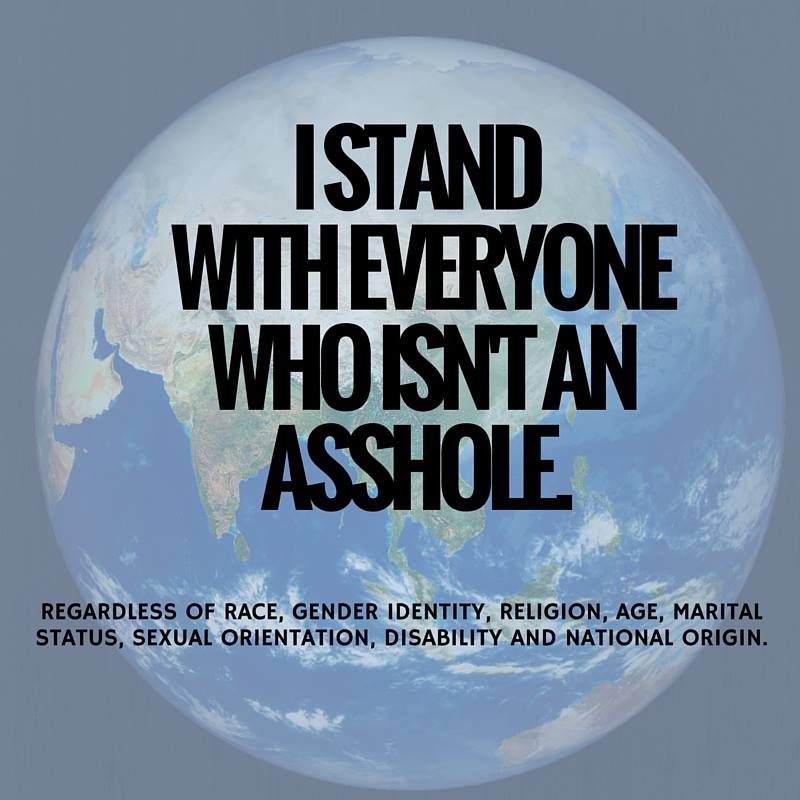
"I stand with everyone who isn't an asshole.  Regardless of race, gender identity, religion, age, marital status, sexual orientation, disability and national origin."

 Image result for i stand with everyone who isn't an asshole

You can add "political allegiance" to that list, too.

Monday, October 31, 2016

Shiny Things in the Vending Machine

Why would anyone want to be a politician?

I know it seems like a really simple question.  And I know those in political lives right now would answer this in the most Miss America way they possibly could.

"I want to bring positive change to the world."

"I want to serve my community."

"We deserve leadership."

All lovely platitudes.  But it kind of feels like hogwash nowadays, doesn't it?  Sure, there are a few out there who are doing a great job of being public servants.  They represent their constituents well, and they're about as "open book" as you can get.

But it feels like the good apples are being ruined by the bad ones.  And it's making it tougher for the good apples to want to even get in the basket.

Think about it.  Would you be willing to open up your entire life for the world to see?

You would be subjecting your family and friends to an insane amount of scrutiny.  Your husband or wife will be judged for everything they did or do, how they look and how they interact with others.  Your children will be put into an unwarranted spotlight.  As they get older, they will be put under the microscope for every social situation they find themselves in.  Your friends will have to be extra-careful to make sure they don't post anything on social media that could lead to some kind of controversy, even if it's as simple as you having a beer.

Then you get into the partisanship aspect.  You will have your values and beliefs ripped apart.  You could be the most saintly person on the face of the planet, but if you're not of a certain religious background, you will be torn to shreds by some followers of other faiths.  Support same-sex marriage?  Good luck with those who don't support it (they'll wish you a lifetime of damnation).  Question gun control?  They'll think you want to take away their guns (even if all you want is to end school shootings).  Support the oilsands?  The environmentalists will picket outside your home and office in a heartbeat (even though the hypocrisy they show is always so evident).  The insanity is going to come from all sides.  So buckle up, kid!

And don't even get me started on ideas and change.  Have a good idea?  Park it.  Because someone will think you're targeting them, or that you're threatening their way of life.  And make sure your ideas are simple.  Because if people have to think, they will revolt because it feels like you're talking down to them.  They want your ideas in 140 characters or less.  So get practicing.

Many people have asked the question about "where have all the good candidates gone?"  The joke with the American election, for example, has been about how there are 330-million people and these are the two best candidates to run the United States?

Is this an accident?

I have a feeling the answer is no.  Most of the "good" candidates (the ones of sane mind and best intentions) are in hiding.  Why?  Ask yourself the above questions about what you'd be willing to sacrifice.

But ask yourself, as a voter, about what you've come to expect from politicians.  Many people expect the absolute worst.  They think they need to be some combination of morally corrupt, fiscally incompetent and/or reality-deprived.  And if they can't find it on the cover of the book, don't worry, they will go digging for it.  They will find anything, no matter how minuscule, to throw you under the bus.  Why?  There's this nagging feeling that it's "too good to be true", and they don't want to be disappointed later.  It's a different kind of abusive relationship.

Maybe I'm an idealist, but it feels like there was a time when we expected more.  We looked for the good in our candidates.  We looked for people who had a vision, who could get things done and who could work with others.  Even the opposition.

But somewhere along the way, we got lost.  Instead of having visions and working together, opposition politicians scream from the rooftops about how they've been hard done by and how only THEY can fix it.  They campaign on "change" then they enter office and do the exact same thing (or some minor variation) of what they campaigned against.  They don't offer up their own ideas, they simply cry foul.  I once joked that one politician could say "the sky is blue" and opposition politicians would yell back "screw you, the sky is red!"  It happens at all levels, especially in the party system.  They oppose for the sake of opposing because their partisanship tells them to.  Who needs good policy and ideas when you can simply do all you can to discredit your opposition?  It's no wonder it takes forever for ideas to come to fruition.

And it's no wonder people are turned off politics.  They see all the yelling and screaming.  They see all the scandals and discourse.  And they see who they are voting for.  They don't like it.

Maybe we need to hit rock-bottom.  Maybe we need to elect the worst of the worst.  Maybe then we'll start looking for the best in candidates and the best candidates.  Maybe then we'll start seeing some of the best coming forward, all with well-thought out policy ideas and plans.  Maybe they'll even have a shred of moral decency.  Maybe they won't come in with a bunch of vested interests outside of serving the common good.

We should be taking this "democracy" thing seriously.  Instead, we're mocking it.  We've seemingly allowed ourselves to devolve into a giant junior high school council election, where only the well-known kids get voted in.  It doesn't matter if they're promising nothing or they're promising soda machines in every classroom and five recesses a day.  They might be bullies or have an IQ of a stick.  But they're popular.

Meanwhile, the smart kids in the corner of the classroom, with all the good ideas in the world and decent human compasses, are sitting on the sidelines, knowing they stand a snowball's chance in you-know-where of winning this thing.

It's not that the vote is rigged.

It's just that no one is taking them seriously, because the electorate is distracted by shiny things in the vending machine.

Thursday, October 27, 2016

Here's The Trouble...

"The right-wing is just a bunch of crazy, bigoted morons!"

"The left-wing is so afraid of offending anyone!"

"We need to clean out police departments because they're filled with corruption!"

"Teachers are lazy!"

"The media is biased!"

Something's been eating at me lately.  I wasn't exactly sure what it was, but it's finally dawned on me, particularly when you see the last five statements read together.

Generalizations need to stop!

Somehow, some way, we've allowed ourselves to make sure we group everything we hate into one finite group without ever needing to question that group.  Let me explain with the first example.

We all know the right-wing in politics is represented by Conservatives (in Canada) or Republicans (in the USA).  Anyone who opposes these viewpoints is automatically labeled in some way (depends on the person), but all in the same way.  So if one Conservative is also a meat eater, than all Conservatives are meat eaters.  And that's not necessarily true.  So why is that we allow the generalizations to be made on a bigger scale, like that if you're a Conservative but also anti-gay, then that must mean that all Conservatives are anti-gay.  That's obviously not true, but yet that painting is still being shown.

Let's move to groups like police, teachers and nurses.  Some people will proclaim that they are "lazy".  But are they?

Not even a little bit.

Look at police and how they're characterized as being ruthless, gun-toting thugs.  Is that true of all?

Absolutely not.

And how about that dastardly media?  As I've pointed out in the past, there is no "the media".  It's not like there are these grand meetings featuring gold name plates and caviar, where reporters and anchors determine what kinds of stories we are going to be feeding to the masses.  "The media" is simply code for those particular outlets that you don't agree with but feel the need to lump together.

Here's the deal: you're letting a bad apple or two ruin your perception of how the group (generally) acts as a whole.

And if you don't believe me on this, then let me throw another one to you: all sports reporters are cheerleaders.  Sounds outlandish doesn't it?  Yet, there are those who are labeled as cheerleaders by some followers.  So in theory, that original statement should hold true.

Here's another one: office workers are lazy.  Of course, that's not true either.  But why is it okay not to say that, when some people think it's okay to call rig workers "buffoons who couldn't get through high school"?

And don't say any of these generalizations aren't made, because they are.  I see it on a regular basis.  Different sides to different debates, battling it out over who can be pound their chest and hold ultimate supremacy over each other.  It's hogwash.  Absolute and utter hogwash.

Because the world isn't black and white.  No matter how hard you try.

There are fiscal conservatives who aren't bigots.

There are social progressives who want their tax money watched carefully.

There are good police officers who serve their communities well.

There are great teachers who are trying to make the world better for kids.

And there are reporters and media outlets out there acting as a public service for information.

I'm willing to bet some of these good people are just dying to get their stories out there.  They hate being characterized in the same light as the idiotic generalizations that follow them around day after day.

I'm not saying there isn't rot in the world and it doesn't need to have the light shine down on it.  But what I am saying is that the rot shouldn't be allowed to infect everything, including our judgment, to allow for generalizations to bury the good happening out there.

Because there is good in the world.  You just need to start looking for it.

Friday, October 14, 2016

"Bad News" vs. "Good News"

I hear it all the time.

"Why can't we have more good in newscasts?"

It's certainly something that's hard to ignore.  We are constantly bombarded with death, destruction, controversy and scandal.  Some people have decided to tune it out, and I don't necessarily blame them.  It's admittedly hard on reporters and others in "the news" to deal with the constant negativity, I can only imagine what it's like for someone outside of that circle to deal with on a daily basis.  The result?  An uptick in the number of "good news" stories being passed around.

It begs a really interesting question in the grand scheme of things: what is a good mix of "bad news" and "good news"?

You see, not everyone likes good news.  In fact, some detest it.  Whenever you see a good news story mixed into the run, you will see some pretty normal reactions.  "This isn't news", "must be a slow news day" or "there are bigger stories you should be reporting on."  It happens EVERY time.  So, as a reporter, you're a little gun-shy to do those kinds of stories.


The other interesting reaction happens when it comes to organizations that don't necessarily get positive stories.  Let's use police as an example.  Every so often, you see the stories about officers doing good things.  A reporter will cover that story, but then get lambasted for playing "public relations" for police, trying to cover up whatever scandal might be out there.  Same goes for politicians.  Heck, even when we do feel good stories about a birth at the Calgary Zoo, some people will complain about how it's covering up the wrongs happening at the Zoo.  It's a no-win proposition.

I've had this conversation with a few different people, both in the industry and out of it, because I've always believed in having a wide-ranging discussion about these kinds of things, in hopes of getting a better-rounded product for my listeners.  The challenge is finding balance.  You can't ignore the bad happening in the world, but you also can't shy away from the good.

Is the old adage of "if it bleeds, it leads" dead?  Does sex still sell?  I remember being told that good news just doesn't work.  No one pays attention to it.  I'm curious, in the day-and-age of the internet, if that is all changing.

I'm also curious about the societal impact of having more "good news"?  Would people be more-inclined to do good things if they knew there was good out there in the world?  Would people feel better about the world if they had better news around them?  Or would they simply sluff it off after a while, saying it's "not really news" or that it's "propaganda for those with something to hide"?  Then, of course, that fuels that "mainstream media" hatred that seems to be making the rounds.

Don't get me wrong.  I still believe in the power of investigative reporting.  Accountability is extremely important and should be viewed as such.  We can't not report on the bad things around our communities and around our world either.

But the question still remains: is there room for some good news in the world as well?

Saturday, October 1, 2016

What If We're All Wrong...

Every so often, I get phone calls in the newsroom from people who take issue with how certain stories are written or are perceived to have been written (because let's face it, some people hear what they want to hear).

Sometimes, they are ridiculous phone calls that I try to end in the first couple of minutes.  The accusations can go from fairly tame to downright aggressive.  And that's fine.  Everyone has their right to an opinion and I can handle it.  In all of those cases, I present the facts, as they're laid out, and a reasoned discussion on how and why a story was covered.  I'd say 99% of those who call irritated hang up the phone feeling a little less upset and, at the very least, a little more enlightened.

But once in a while, I get a phone call from a listener who makes me think a little.  Such was the case today with a gentleman who wanted to talk about the state of the economy in Alberta.  He didn't want to pin blame on anyone in particular, but felt like Albertans should all be taking responsibility for where we're at now.

He seemed to be of the mindset that we missed opportunities years ago in trying to diversify our economy.  Whether it was in technology, manufacturing or some other industry, we seemed to miss the boat because we had the blinders on, thinking that we could live off the avails of oil and gas forever.

But on the flipside, he was also unimpressed that we're now seemingly trying to make up for lost time by diving head-first into a number of different "possible" sectors, while throwing our "bread and butter" under the bus.  He compared it to throwing mud against a wall to see what will stick.

Then he brought up the most interesting point of all: what is Alberta going to look like in 50 years?  Will it be all oil and gas?  Will it be solar and wind?  Will we discover some other revenue stream that will keep this province humming along? 

I didn't have the answer to him, but I then asked him if he's heard any vision on that topic from anyone.  And that's the point he wanted to make.  He went on to say that while politicians and political watchers stumble over themselves trying to pin the blame on others, we haven't really heard anything about what a future Alberta could look like, with or without oil and gas.

It was a very interesting conversation, and as I sit here and dissect it, it made me think of a few questions that I think we should be pondering:

#1. Are we afraid of economic diversification, or are we afraid of the potential of walking into an unknown world, away from oil and gas?

#2. What does this mystical creature known as "economic diversification" look like, and how does it pertain to Alberta?

#3. Should we be willing to throw the oil and gas industry out with the bath water while we go searching for this mystical creature, or should we trying to make it fluorish while we go on our expedition?

#4. What if those who think we can shut off the oil and gas taps right away are wrong?

#5. What if those who think nothing should change and we can live off oil and gas forever are wrong?

Personally, one of the challenges we're having with this discussion is that we're trying to have it 140-characters at a time.  It's an issue I think with many different debates, to be honest.  We should be opening up the dialogue and not be afraid to ask some pretty point questions, demanding well-thought out answers.

We owe it to ourselves.

Thursday, September 15, 2016

What If We Tried This...

Every so often, I get a little poli-nerdy.

It comes from a fascination with political systems and math.  As I've become more entrenched in the political world as a reporter, I've been able to see a number of elections transpire with a variety of outcomes.  And after every election, there's always talk about electoral reform.

You see, whenever someone loses an election, there's an instant belief that the numbers don't make sense.  How can a party garner 35-40% of popular support, command 80% of the legislature or House of Commons?  This is nothing new to the game, as political parties from both sides of the spectrum have cried foul over the representation not necessarily mirroring what the popular vote says.

So what would electoral reform look like?  Is it representation-by-population?  Is it a set number of delegates from each province and territory (ie 5 for each)?  Even beyond that is the argument over how to get more people out to vote.

I'm going to propose something a little crazy.  What if we did a mish-mash of the different kinds of systems out there?

Here's what I'm thinking: each party runs in an election with a "depth chart".  In Alberta, you would have your leader, deputy leader, finance minister, agriculture minister, justice minister, and on and on.  In federal politics, same idea, with maybe a BC Minister, Alberta Minister, etc, to go along with your standard ministries (and maybe you want to give some more than one portfolio, so the justice minister is also Manitoba minister).  This gives the electorate an understanding of how big your cabinet would be, where your strengths are, what you think will be important portfolios, and that kind of thing.

Then come election day, whatever percentage of the vote you get is how many seats you end up receiving.  So in Alberta, we have 87 seats.  Let's say the top percentage vote is 43%, so you will end up with 37 seats.  You end up with 8% of the vote, you get 7 seats.  So each party will pick their best people to sit in those seats while the rest can work as advisers or whatever the case may be.

Add in fixed election dates and recall legislation and I think you make the case for forcing parties to work together for the greater good.  The fixed election dates mean you can't have opposition parties with non-confidence motions forcing another election, and utilize recall legislation for the entire group, so if we, as the electorate, feel we're not being served, we can toss those not getting along.

I know the one argument against this idea will be that we're essentially taking local representation away.  And while I don't necessarily disagree, how often have we seen it where local MLAs or MPs are nothing more than puppets for the party anyways?  I know of politicians who sat for years or even decades without doing anything of real substance, never sat as cabinet ministers, yet continued to get voted in because they were with the governing party.  What if this new kind of government would force governments to hear concerns of all Albertans (or Canadians), rather than listen to only those in their own jurisdictions, so that they can get a "full picture" of each of their decisions?  Interestingly enough, I do believe in local representation.  But I also vote based on who will be the best representative for me and for the people in my riding.  As weird as it sounds, I'd rather have my representative be effective in opposition, rather than be a lap-dog with the governing party.

I'm not pretending to have all the answers or to understand all the ins and outs of how this system would totally work.  But maybe this can be a bit of a discussion-starter when it comes to thinking outside the box, rather than believing that the system can only work in one of two or three ways.

Because the definition of insanity is doing the same thing over and over and over again while expecting a different result.  And that's sort of how it feels when it comes to election reform.