Needless to say, it has been a crazy few months, hence the lack of movement on this here blog. Not only did we launch the new website for Alberta Dugout Stories and a new blog site for Canes This Week, but I bought a house with my wonderful girlfriend and the world of radio news hasn't exactly been slow either. More on that in a moment...
But first, I wanted to provide everyone with an update on a little pilot project that I introduced you all too a while back.
READ MORE: Teaching What I Preach
Well, it's on! We had to delay it a bit because of some timing and the summer infringing on getting the word out. But early in the school year, the word got out and starting this week, I'll be taking four young people under my wing to show them the ropes on being a PA announcer and game-day host.
So over the past couple of weeks, I've been trying to figure out how exactly I'm going to pass on some of my knowledge to them. Admittedly, I'm a bit scared of the two classroom sessions we have planned. Part of it is that I'm more comfortable in front of 15,000 than I am in front of a smaller group like that. But the other part is making sure they walk away with the motivation and confidence to stand in front of their peers and talk.
I've been able to narrow it down to a few key points:
#1. Be prepared - I'm practicing what I preach here. On the drive to and from work, I've actually been talking to myself and preparing what I should be saying to them. I've been recording some voice notes with some key points that will serve as my "curriculum." I want them to get as much out of each session as possible.
#2. Be ready - anything and everything will come your way. If something changes, you need to go with the flow. Not everything is scripted (and in my case, almost nothing is really scripted when I'm hosting).
#3. Be thick-skinned - it's important not to care about what other people thing...to an extent. They should care about honest feedback and criticism. They shouldn't care about what might come their way in terms of what some people will say, particularly their peers. That's a tough hoop to jump through. But once I stopped caring about the opinions of those that don't matter, it made my job way easier and way more fun.
So I'll be chatting with the kids a couple of times in the classroom and then they will shadow me in my various roles with different teams over the next couple of weeks, with the hope that they'll be comfortable enough to do some things for their school in November and December. So fingers crossed, this will be something fun!
*****
One of the questions I always get this time of year is: where do you find the time to do all of this? I think I've finally figured out how and it's really quite simple.
I love what I do. Each and every game, I take a moment to breathe in the air and the atmosphere. I make sure to smile and really soak it all in. Very few people have had the chance to do what I've done. It would be easy to go home after a work shift and disappear. But you only get one chance to live this life, and I want to be able to tell my grandkids that I was "cool" once upon a time.
READ MORE: My "Other" Job
The other part is that I do believe in the power of sports. For many, it's an escape from whatever is going on in the world. It's a chance to unwind and it can transcend every divisive aspect of our daily lives. My small role here is simply to give the average fan something different from what they're getting at home. Whether it's a high-five, a t-shirt, a prize or just a chuckle, I've felt like I've done my job.
Where do I find the time? Easy. 24 hours in a day and I take full advantage of it. It does take discipline and the ability to say "no" once in a while (although I haven't said that word very often in the last six years or so.)
Will this wild ride of hosting end? Of course it will. When? I haven't the slightest. But what I do know is that I'll milk it for all it's worth. I might not say it enough, but I owe it to my family and friends for being so understanding but also so supportive of all I've done thus far in my career as the "Ryan Seacrest of Calgary sports hosting."
Let's continue to "Make Some Noise" and have some fun together, shall we?
Tuesday, October 10, 2017

Monday, July 10, 2017
Origins of "Vulture"
The story behind the "vulture" moniker is a fairly simple one.
I was sitting in the second of three rows in one of the courtrooms in Calgary, covering a manslaughter trial, when a family member of the suspect turned around, looked at what I was doing (writing in my notepad) and called me a "f****** vulture." It caught me off-guard for sure, being called out for doing my job and reporting on the facts laid out in the courtroom. But I didn't dignify it with a response. I lightly joked about it with a few friends, who still call me "Vulture" once in a while. But at the time, I never would have thought that name would have been the tip of the iceberg.
Over my last twelve years in journalism, it has been startling to see the shift in attitude towards the so-called "mainstream media." Part of it, to be honest, was naivete, as part of it was spent as a news anchor/co-host, where I wasn't immersed in the real grind of reporting. The other part has to do with what's seemingly become more acceptable in our society: people are acting out and even applauding violence (both physical and emotional) on journalists.
This idea has evolved over time. It used to be a few spoken words or people jumping in front of a live TV shot to do something silly. Then we had smaller altercations, like people trying to rip microphones out of hands (as has happened to me) or shouting the infamous FHRITP into live microphones. We now have the internet, where everyone has access to a sounding board to yell whatever they would like at anyone they want to target, with no circumstances for their actions.
What worries me now is even through all of that, we're evolving even more. Much has been said about the gif featuring US President Donald Trump and a CNN logo-faced man and how some believe this is inciting violence against reporters. But we've already had more serious altercations.
READ MORE: Republican 'body slam' caught on Guardian reporter's tape
READ MORE: Man pleads guilty to uttering threats against Rebel staffer at women's march
It shouldn't matter what political stripe you wear, who you are, what organization you're with or the cause you stand for, the one thing that we should all be clear about is that violence shouldn't be tolerated at all. It also shouldn't matter if you agree or not with the media outlet, the fact is these are human beings and no one deserves to be belittled or assaulted for doing their job.
All of this worries me and should worry anyone else who believes in freedom of the press. We're now running the risk of journalists feeling bullied or pressured into not pursuing stories that could be of importance. These journalists also shouldn't have to live their lives not knowing the amount of danger they could be entering.
To share another story: over the last year, I've been personally attacked for how my team covered a story. It devolved into a few different insults, but also a couple of quite nasty emails. After a couple of days, it got to the point where I called my parents and others to tell them not to post or like anything on political social media sites. Why? Because I was afraid that some of these people would notice the last name and inundate my loved ones with hateful messages. I know some of these trolls will go to great lengths to get their message across and know no bounds in terms of how vile they get. I didn't want my loved ones to get dragged into the middle of it. And luckily, they didn't.
But I can't say the same for others who have been threatened and harassed. And my worry is that this phenomenon will only get worse as basic human decency takes a backseat to political affiliation and propaganda.
As I have said on Facebook, I've never held back on stories knowing what the commentary will be after the fact. Because facts are facts and stories are stories. But I will admit it gets harder and harder to look at comment sections and there are times when I don't want to post stories on social media. Why? Because it has seemingly become a game now of "who can be more vile." It's not that I'm intimidated. I'm just sick of seeing the worst in humanity, hiding behind the cloak of "freedom of speech."
READ MORE: Online trolls mustn't be allowed to intimidate journalists
My message to my journalist friends out there: please take care of yourselves. I know I've said this before, when it comes to covering emotionally-charged stories. But this time, I mean it in a couple of other ways.
First, on the social media front, stories with backlash can take a huge emotional toll on you. You'll be told not to take it personally or take it seriously, but that'll be impossible. The easiest thing I found was to simply mute or block the perpetrators and not give them the time of day. They say "don't feed the trolls." That you CAN do.
Second, when you're out doing your job, you need to double-down on a couple of things. You have to be cautious of your surroundings, know who you're dealing with and act accordingly. But secondly, you can't do anything that could be looked at as "provoking." I'm not saying you can't be aggressive in the pursuit of the story, but there are ways to get that done without a potential bump or run-in. The last thing you want to do is make yourself part of the story.
Call me an optimistic idiot. But I believe we all have the power to help change the trajectory of this trend. We're all going to have to work together on this and it starts with having an open and honest discussion about it.
I was sitting in the second of three rows in one of the courtrooms in Calgary, covering a manslaughter trial, when a family member of the suspect turned around, looked at what I was doing (writing in my notepad) and called me a "f****** vulture." It caught me off-guard for sure, being called out for doing my job and reporting on the facts laid out in the courtroom. But I didn't dignify it with a response. I lightly joked about it with a few friends, who still call me "Vulture" once in a while. But at the time, I never would have thought that name would have been the tip of the iceberg.
Over my last twelve years in journalism, it has been startling to see the shift in attitude towards the so-called "mainstream media." Part of it, to be honest, was naivete, as part of it was spent as a news anchor/co-host, where I wasn't immersed in the real grind of reporting. The other part has to do with what's seemingly become more acceptable in our society: people are acting out and even applauding violence (both physical and emotional) on journalists.
This idea has evolved over time. It used to be a few spoken words or people jumping in front of a live TV shot to do something silly. Then we had smaller altercations, like people trying to rip microphones out of hands (as has happened to me) or shouting the infamous FHRITP into live microphones. We now have the internet, where everyone has access to a sounding board to yell whatever they would like at anyone they want to target, with no circumstances for their actions.
What worries me now is even through all of that, we're evolving even more. Much has been said about the gif featuring US President Donald Trump and a CNN logo-faced man and how some believe this is inciting violence against reporters. But we've already had more serious altercations.
READ MORE: Republican 'body slam' caught on Guardian reporter's tape
READ MORE: Man pleads guilty to uttering threats against Rebel staffer at women's march
It shouldn't matter what political stripe you wear, who you are, what organization you're with or the cause you stand for, the one thing that we should all be clear about is that violence shouldn't be tolerated at all. It also shouldn't matter if you agree or not with the media outlet, the fact is these are human beings and no one deserves to be belittled or assaulted for doing their job.
All of this worries me and should worry anyone else who believes in freedom of the press. We're now running the risk of journalists feeling bullied or pressured into not pursuing stories that could be of importance. These journalists also shouldn't have to live their lives not knowing the amount of danger they could be entering.
To share another story: over the last year, I've been personally attacked for how my team covered a story. It devolved into a few different insults, but also a couple of quite nasty emails. After a couple of days, it got to the point where I called my parents and others to tell them not to post or like anything on political social media sites. Why? Because I was afraid that some of these people would notice the last name and inundate my loved ones with hateful messages. I know some of these trolls will go to great lengths to get their message across and know no bounds in terms of how vile they get. I didn't want my loved ones to get dragged into the middle of it. And luckily, they didn't.
But I can't say the same for others who have been threatened and harassed. And my worry is that this phenomenon will only get worse as basic human decency takes a backseat to political affiliation and propaganda.
As I have said on Facebook, I've never held back on stories knowing what the commentary will be after the fact. Because facts are facts and stories are stories. But I will admit it gets harder and harder to look at comment sections and there are times when I don't want to post stories on social media. Why? Because it has seemingly become a game now of "who can be more vile." It's not that I'm intimidated. I'm just sick of seeing the worst in humanity, hiding behind the cloak of "freedom of speech."
READ MORE: Online trolls mustn't be allowed to intimidate journalists
My message to my journalist friends out there: please take care of yourselves. I know I've said this before, when it comes to covering emotionally-charged stories. But this time, I mean it in a couple of other ways.
First, on the social media front, stories with backlash can take a huge emotional toll on you. You'll be told not to take it personally or take it seriously, but that'll be impossible. The easiest thing I found was to simply mute or block the perpetrators and not give them the time of day. They say "don't feed the trolls." That you CAN do.
Second, when you're out doing your job, you need to double-down on a couple of things. You have to be cautious of your surroundings, know who you're dealing with and act accordingly. But secondly, you can't do anything that could be looked at as "provoking." I'm not saying you can't be aggressive in the pursuit of the story, but there are ways to get that done without a potential bump or run-in. The last thing you want to do is make yourself part of the story.
Call me an optimistic idiot. But I believe we all have the power to help change the trajectory of this trend. We're all going to have to work together on this and it starts with having an open and honest discussion about it.
Sunday, May 7, 2017
Home Sweet Home
I've rented for pretty much my entire adult life.
It's not something that you typically scream from the rooftops, as it has this sort of unofficial aura to it where you haven't really entered adulthood until you have a mortgage. And there's a certain air of truth to that, as it carries a boatload of responsibilities to it.
That's not to say that I'm not a responsible guy. I've always been a solid tenant (mainly because I'm never home). I always pay my rent on time, always keep the place neat and tidy (for the most part) and really don't even have people over, as I know how I feel when I hear loud music and people meandering through the building, so I don't like imposing that on others.
Yet, for some reason, being a renter also carries with it the burden of being looked down on by some homeowners. All you need to do is see the back-and-forth that always happens when secondary suites are debated at any city council. Look at what happens when apartment buildings are contemplated in areas traditionally-known as being single-family home areas. You hear the same arguments over and over and over again about increases in crime, lack of parking, transient populations, etc.
Is some of it true? Sure. Not all renters are the greatest in the world. But there are also those of us who are great renters who would be a benefit to a community. Your community. All they're looking to do is get themselves in a spot where they can save some money, which will be used for that down payment on their first home. Believe it or not, that's a lot harder to do than some would make you believe, particularly when you're spending an arm and a leg to rent or when you're not making six digits a year, plus battling debt you've accumulated going to school, etc.
I think it's a combination of hard work and luck that I'm in the situation I'm in. I promised myself that by the age of 30 I'd be debt-free (vehicle, student loans, credit cards) and I made it happen. Then it was a matter of saving money, first to buy a new car, then to get enough scratched together for that down payment. I'm there now. And while I've talked a lot about buying my first home, it's finally going to be a reality this summer with my wonderful girlfriend.
With it, comes all of the responsibilities, and a lot of questions. Even at 34, I can openly admit there's a level of "scared" involved in this. Because it's not part of my DNA. My family lived on the farm, so it wasn't like we were changing houses all the time. And as I sometimes joke, the education system was great at showing us what the Pythagorean Theorem is all about, but I'll be jiggered if it taught me about the ins and outs of day-to-day life like buying a house or getting a line of credit. Everything in this is "guess and test". Sure, lots of friends can help us out (which we're forever grateful for) and the internet is overloaded with information, but until you actually go through the process and get your hands dirty, you don't necessarily know what you're getting yourself into.
This is all coming from a guy who is a "manager". I'm well-educated and financially-savvy. Yet it's tough feeling super-confident about going head-first into this process, bargaining for a good price and making sure you have all your I's dotted and T's crossed.
I'll be forever grateful for the places I've been able to live, as they have all taught me a number of lessons that will undoubtedly help us as we begin down this path of home ownership.
My point with this blog is this: if you're a regular at slamming renters for being lazy or disrespectful or any other generalization you enjoy falling back on, stop and take a deep breath. Not everyone is at the same point in life as you are. Not everyone has the financial means to cobble together a down payment or afford mortgage payments right this very minute. That doesn't necessarily make them the blight on society you may think they are.
Many hope to be in the exact same position you're in. So maybe it's worth cheering them on.
It's not something that you typically scream from the rooftops, as it has this sort of unofficial aura to it where you haven't really entered adulthood until you have a mortgage. And there's a certain air of truth to that, as it carries a boatload of responsibilities to it.
That's not to say that I'm not a responsible guy. I've always been a solid tenant (mainly because I'm never home). I always pay my rent on time, always keep the place neat and tidy (for the most part) and really don't even have people over, as I know how I feel when I hear loud music and people meandering through the building, so I don't like imposing that on others.
Yet, for some reason, being a renter also carries with it the burden of being looked down on by some homeowners. All you need to do is see the back-and-forth that always happens when secondary suites are debated at any city council. Look at what happens when apartment buildings are contemplated in areas traditionally-known as being single-family home areas. You hear the same arguments over and over and over again about increases in crime, lack of parking, transient populations, etc.
Is some of it true? Sure. Not all renters are the greatest in the world. But there are also those of us who are great renters who would be a benefit to a community. Your community. All they're looking to do is get themselves in a spot where they can save some money, which will be used for that down payment on their first home. Believe it or not, that's a lot harder to do than some would make you believe, particularly when you're spending an arm and a leg to rent or when you're not making six digits a year, plus battling debt you've accumulated going to school, etc.
I think it's a combination of hard work and luck that I'm in the situation I'm in. I promised myself that by the age of 30 I'd be debt-free (vehicle, student loans, credit cards) and I made it happen. Then it was a matter of saving money, first to buy a new car, then to get enough scratched together for that down payment. I'm there now. And while I've talked a lot about buying my first home, it's finally going to be a reality this summer with my wonderful girlfriend.
With it, comes all of the responsibilities, and a lot of questions. Even at 34, I can openly admit there's a level of "scared" involved in this. Because it's not part of my DNA. My family lived on the farm, so it wasn't like we were changing houses all the time. And as I sometimes joke, the education system was great at showing us what the Pythagorean Theorem is all about, but I'll be jiggered if it taught me about the ins and outs of day-to-day life like buying a house or getting a line of credit. Everything in this is "guess and test". Sure, lots of friends can help us out (which we're forever grateful for) and the internet is overloaded with information, but until you actually go through the process and get your hands dirty, you don't necessarily know what you're getting yourself into.
This is all coming from a guy who is a "manager". I'm well-educated and financially-savvy. Yet it's tough feeling super-confident about going head-first into this process, bargaining for a good price and making sure you have all your I's dotted and T's crossed.
I'll be forever grateful for the places I've been able to live, as they have all taught me a number of lessons that will undoubtedly help us as we begin down this path of home ownership.
My point with this blog is this: if you're a regular at slamming renters for being lazy or disrespectful or any other generalization you enjoy falling back on, stop and take a deep breath. Not everyone is at the same point in life as you are. Not everyone has the financial means to cobble together a down payment or afford mortgage payments right this very minute. That doesn't necessarily make them the blight on society you may think they are.
Many hope to be in the exact same position you're in. So maybe it's worth cheering them on.
Friday, March 17, 2017
Teaching What I Preach
Time to lift the veil on a little project I've been working on for a while now.
But before I do, I will admit that it feels like this is said a lot on this blog. "Man, it's been a while since I've written anything." Truth be told, there's been lots on the go and the blog took a seat on the bench. Between life at the radio station and in hosting, plus life with my wonderful girlfriend, family and friends, I haven't had a ton of time at home to entertain the masses.
That being said, it hasn't meant I've been sitting on my tush elsewhere. I've hinted that I have a couple of mini-projects in the works and I'm here now to explain one of them.
It actually all started with a couple of passing comments while I was volunteering as PA announcer with Calgary Bantam Football. Every so often, I'll get a word of "thanks" or someone asking if I could work high school games. I had to politely decline, but it got me thinking. And we all know where that goes...

It got me into some conversations. Eventually, it led to one with Joy Bowen-Eyre from the CBE, who pointed me in the direction of a couple more people, which took me to the Calgary Senior High School Athletics Association board meeting a week ago Monday. That's where I made a short presentation and pitch on my idea.
The Pitch
A pilot project where we would get four or five kids from four or five high schools into a classroom, where I would teach them how to be an announcer for their own schools. I'd give them some tips and tools on speaking, the formatics and preparation involved in announcing games, maybe bring them to a CBFA game or to the radio station so they can soak in some of the knowledge from others in the business.
My big goal here is to get kids who aren't normally part of their sports teams to actually be involved in another way. Maybe they have physical limitations or are simply not good enough to play, but maybe they are in drama and have a killer voice or an encyclopedia for a sports mind and a great attitude. Why not allow those kids to be a part of their team in a different way? Frankly, it's how I've made my career.
Now all of a sudden, we could have kids in different social circles interacting with one another. Now we're building school spirit and pride with a different kind of atmosphere on the court or on the field.
And for the kid, these kinds of skills are transferable. They can take these experiences wherever they go, whether it's continuing the announcing in post-secondary and beyond, or whether it's simply to have the confidence to speak in public, which is a major fear for a lot of people.
For the schools, I feel like this is a win-win as well. Now you have a kid who is comfortable in front of a microphone and in front of a crowd, and they can now be the MC for pep rallies and assemblies, or maybe the school needs an "official voice" for online videos being created. The options, in my mind, are endless.
So the idea is now in the hands of the schools, who have the information and can use it to find a student who they think could do this. Hopefully I'll hear back in the next few weeks from those interested, and we can start building a bit of a curriculum or game-plan on getting these kids involved. By all means, if you know someone who might be interested in something like this, have them give me a holler.
I'll keep you all posted on how this thing turns out, but I'm super-stoked at the possibilities.
But before I do, I will admit that it feels like this is said a lot on this blog. "Man, it's been a while since I've written anything." Truth be told, there's been lots on the go and the blog took a seat on the bench. Between life at the radio station and in hosting, plus life with my wonderful girlfriend, family and friends, I haven't had a ton of time at home to entertain the masses.
That being said, it hasn't meant I've been sitting on my tush elsewhere. I've hinted that I have a couple of mini-projects in the works and I'm here now to explain one of them.
It actually all started with a couple of passing comments while I was volunteering as PA announcer with Calgary Bantam Football. Every so often, I'll get a word of "thanks" or someone asking if I could work high school games. I had to politely decline, but it got me thinking. And we all know where that goes...

It got me into some conversations. Eventually, it led to one with Joy Bowen-Eyre from the CBE, who pointed me in the direction of a couple more people, which took me to the Calgary Senior High School Athletics Association board meeting a week ago Monday. That's where I made a short presentation and pitch on my idea.
The Pitch
A pilot project where we would get four or five kids from four or five high schools into a classroom, where I would teach them how to be an announcer for their own schools. I'd give them some tips and tools on speaking, the formatics and preparation involved in announcing games, maybe bring them to a CBFA game or to the radio station so they can soak in some of the knowledge from others in the business.
My big goal here is to get kids who aren't normally part of their sports teams to actually be involved in another way. Maybe they have physical limitations or are simply not good enough to play, but maybe they are in drama and have a killer voice or an encyclopedia for a sports mind and a great attitude. Why not allow those kids to be a part of their team in a different way? Frankly, it's how I've made my career.
Now all of a sudden, we could have kids in different social circles interacting with one another. Now we're building school spirit and pride with a different kind of atmosphere on the court or on the field.
And for the kid, these kinds of skills are transferable. They can take these experiences wherever they go, whether it's continuing the announcing in post-secondary and beyond, or whether it's simply to have the confidence to speak in public, which is a major fear for a lot of people.
For the schools, I feel like this is a win-win as well. Now you have a kid who is comfortable in front of a microphone and in front of a crowd, and they can now be the MC for pep rallies and assemblies, or maybe the school needs an "official voice" for online videos being created. The options, in my mind, are endless.
So the idea is now in the hands of the schools, who have the information and can use it to find a student who they think could do this. Hopefully I'll hear back in the next few weeks from those interested, and we can start building a bit of a curriculum or game-plan on getting these kids involved. By all means, if you know someone who might be interested in something like this, have them give me a holler.
I'll keep you all posted on how this thing turns out, but I'm super-stoked at the possibilities.
Tuesday, January 17, 2017
The Big Picture
I'm not a big fan of spouting my mouth off without thinking long and hard about a topic. I like to give things context. I like to be the devil's advocate. And I like to ask hard questions, even of myself.
This blog is not about politics or anything controversial, like I tend to do. Instead, I want to talk about the above challenge and an experience this week, and hope that you guys take something away from it.
My new Chevy Equinox was broken into on Sunday night/Monday morning. The back passenger door window was smashed out, which I wasn't obviously impressed about. Upon further inspection, I realized that my big Calgary Stampeders jacket and toque were the items taken from the backseat (which I had left back there as part of an emergency kit, in case I broke down or was involved in a wreck in a not-so-populated area).
It's an inconvenience to be sure. It makes you feel kind of violated, having something of yours vandalized. I'll admit I went through a bit of an emotional roller-coaster, not knowing exactly how I should feel.
You see, I was mad for about a minute. Honestly, I was more mad at myself for avoiding the message that I've heard and even reported on before, about leaving valuables in plain sight. You hear that message around Christmas time especially. I had a momentarily lapse of judgment and it cost me a jacket, toque and $200. It sucks to be sure. But lesson learned.
I'm NOT mad at the person responsible for this. Well, maybe a little. But I also understand the situation. Because there were sunglasses in the front, some change in the console, even some parking passes. None of that was taken. Which tells me that while this was a "crime of opportunity", it also seems to have been a "crime of survival."
You see, it's Calgary and it's January. It's cold outside. People are looking to stay warm. Maybe that person needed the clothing, or knows someone who needed the clothing. In which case, I hope they're able to utilize it. Maybe those responsible were hoping to sell the jacket to make a little cash to put food in their stomachs, or maybe to buy drugs. I honestly have no idea.
But what I do know is that this speaks to the desperation we're seeing on the streets in Calgary. People are needing to invade the private property of others to get their hands on whatever they need to SURVIVE. Yes, it's a choice, but it's also not a choice, if you know what I mean.
Could I want revenge? Could I demand police investigate and bring the offender before the court of law? Sure. But what point does it really prove? It was a petty crime done out of necessity (at least in the mind of the offender). You could throw them in jail for a bit, then when their sentence is done, they're back out, in the exact same situation they were in before. It's no-win for everyone.
My biggest take-away from this is that we should be aiming to care more about each other, as human beings, especially in the midst of this economic recession. Yes, I know this is difficult to think, given that everyone's in self-preservation mode right now. Not to sound too much like a contestant for Miss America, but we're stronger together than we are apart. If we start looking out for one another, trying to give each other a hand UP rather than a hand OUT, the cycle will eventually come to a halt because these people won't need to break into cars or homes or anywhere else to get what they need, whatever it is, to survive.
It doesn't have to be anything big. A moment of your time can go a long way. Maybe it's volunteering at a soup kitchen. Maybe it's giving your old clothes to a charity (we just went through Christmas and I know a lot of people, including myself, who are doing a purge of their closet). The more time the less-fortunate have to spend in getting the essentials for life means the more time they can spend focusing on building themselves back up from the foundation.
I'm not saying what happened is "okay." All I'm saying is "I understand."
#LiveToLove #LoveToLive
This blog is not about politics or anything controversial, like I tend to do. Instead, I want to talk about the above challenge and an experience this week, and hope that you guys take something away from it.
Well this is a nice way to wake up in the morning. Hope whoever took off with my @calstampeders winter jacket enjoys it. #Bankview #yyc pic.twitter.com/pDEj69TeV8
— Joe McFarland (@JoeMcFarland) January 16, 2017
My new Chevy Equinox was broken into on Sunday night/Monday morning. The back passenger door window was smashed out, which I wasn't obviously impressed about. Upon further inspection, I realized that my big Calgary Stampeders jacket and toque were the items taken from the backseat (which I had left back there as part of an emergency kit, in case I broke down or was involved in a wreck in a not-so-populated area).
It's an inconvenience to be sure. It makes you feel kind of violated, having something of yours vandalized. I'll admit I went through a bit of an emotional roller-coaster, not knowing exactly how I should feel.
You see, I was mad for about a minute. Honestly, I was more mad at myself for avoiding the message that I've heard and even reported on before, about leaving valuables in plain sight. You hear that message around Christmas time especially. I had a momentarily lapse of judgment and it cost me a jacket, toque and $200. It sucks to be sure. But lesson learned.
I'm NOT mad at the person responsible for this. Well, maybe a little. But I also understand the situation. Because there were sunglasses in the front, some change in the console, even some parking passes. None of that was taken. Which tells me that while this was a "crime of opportunity", it also seems to have been a "crime of survival."
You see, it's Calgary and it's January. It's cold outside. People are looking to stay warm. Maybe that person needed the clothing, or knows someone who needed the clothing. In which case, I hope they're able to utilize it. Maybe those responsible were hoping to sell the jacket to make a little cash to put food in their stomachs, or maybe to buy drugs. I honestly have no idea.
But what I do know is that this speaks to the desperation we're seeing on the streets in Calgary. People are needing to invade the private property of others to get their hands on whatever they need to SURVIVE. Yes, it's a choice, but it's also not a choice, if you know what I mean.
Could I want revenge? Could I demand police investigate and bring the offender before the court of law? Sure. But what point does it really prove? It was a petty crime done out of necessity (at least in the mind of the offender). You could throw them in jail for a bit, then when their sentence is done, they're back out, in the exact same situation they were in before. It's no-win for everyone.
My biggest take-away from this is that we should be aiming to care more about each other, as human beings, especially in the midst of this economic recession. Yes, I know this is difficult to think, given that everyone's in self-preservation mode right now. Not to sound too much like a contestant for Miss America, but we're stronger together than we are apart. If we start looking out for one another, trying to give each other a hand UP rather than a hand OUT, the cycle will eventually come to a halt because these people won't need to break into cars or homes or anywhere else to get what they need, whatever it is, to survive.
It doesn't have to be anything big. A moment of your time can go a long way. Maybe it's volunteering at a soup kitchen. Maybe it's giving your old clothes to a charity (we just went through Christmas and I know a lot of people, including myself, who are doing a purge of their closet). The more time the less-fortunate have to spend in getting the essentials for life means the more time they can spend focusing on building themselves back up from the foundation.
I'm not saying what happened is "okay." All I'm saying is "I understand."
#LiveToLove #LoveToLive
Friday, December 30, 2016
News Year Resolutions
Those who know me, know I don't actually believe in New Year's Resolutions. They feel like they're made to be broken. We should be focusing on bettering ourselves every day of every month of every year. We should be aiming for bigger and better.
Now, I'm not saying it's not worth having goals. But you gotta be realistic with them, start small, and expand on them through the course of the year. Want to work out? Awesome. But don't jump headfirst into the pool, only to realize you're not seeing massive results right away, so you get discouraged. Want to start a new business? Don't expect millions of dollars right away. You need to work yourself up for it.
Anyways, now that I have that out of the way, I do believe in "lifestyle changes." For a few years, I had a few things that I wanted to do and set out to do them. Whether it was checking out a few more concerts or going to a ballpark, or learning some new recipes and playing more guitar, they were easily attainable. And for the most part, it was a success.
While I was driving around the other day, I got to thinking about "News Year Resolutions" (see what I did there?) As all of you know, I've been on my "mission to civilize" for a while and that won't stop. But what I think I've come up with is a trio of things I can do to help in my mission:
#1. Good News
Sometimes, the trouble with good news is that some people will lean on the old sayings of "must be a slow news day" or "this isn't news." And that's fine. Different strokes for different folks. But there is good in this world. One of my favorite stories I've worked on in the past few years was about a group of homeless men who donated money to a kids' charity. We have to report on the bad news of the world, that's a given. But we can't turn a blind eye to the good stories in the process. My resolution here is to share more of the good stories.
#2. Bad News
When the bad news does hit, it's important for all of us to take care of each other. As I pointed out in a previous blog about the effects of these kinds of stories on reporters, it does pale in comparison to what those truly impacted have to deal with. But we can't sit in silence over it either. These stories expose everyone, from reporters to viewers/listeners/readers, to a roller-coaster of emotion. The story of Taliyah Marsman and her mother, Sara Baillie, struck a particular chord for me this year. These stories are important to tell, especially when it comes to the human element.
#3. Take A Snooze
So many ways I could have gone with this, but the bottom line is we all need to stop and smell the roses at some point. As reporters, we're wired to be "in the know" on everything, but it quickly leads to burn out. Our phones are on all the time and it's easy to let an 8- or 9-hour day turn into 15- or 16-hours. The same goes for consumers. And it's starting to feel like everyone needs to take a Snickers bar. I'm not trying to diminish the sense of urgency, disappointment or disgust you or anyone else is feeling, because it is (for the most part) warranted. But, there comes a point where we have to spend at least a few minutes realizing that the world can be a pretty spectacular place as well. We have to remember: this is real life.
I get the feeling 2016 was a rough, rotten year for a lot of people, for a variety of reasons. Here's hoping the Christmas season (or holidays, or whatever it is you're celebrating) allowed some time for a deep breath. Let's let 2017 be a year of understanding, healing and moving on to making this world a great place to be.
Now, I'm not saying it's not worth having goals. But you gotta be realistic with them, start small, and expand on them through the course of the year. Want to work out? Awesome. But don't jump headfirst into the pool, only to realize you're not seeing massive results right away, so you get discouraged. Want to start a new business? Don't expect millions of dollars right away. You need to work yourself up for it.
Anyways, now that I have that out of the way, I do believe in "lifestyle changes." For a few years, I had a few things that I wanted to do and set out to do them. Whether it was checking out a few more concerts or going to a ballpark, or learning some new recipes and playing more guitar, they were easily attainable. And for the most part, it was a success.
While I was driving around the other day, I got to thinking about "News Year Resolutions" (see what I did there?) As all of you know, I've been on my "mission to civilize" for a while and that won't stop. But what I think I've come up with is a trio of things I can do to help in my mission:
#1. Good News
Sometimes, the trouble with good news is that some people will lean on the old sayings of "must be a slow news day" or "this isn't news." And that's fine. Different strokes for different folks. But there is good in this world. One of my favorite stories I've worked on in the past few years was about a group of homeless men who donated money to a kids' charity. We have to report on the bad news of the world, that's a given. But we can't turn a blind eye to the good stories in the process. My resolution here is to share more of the good stories.
#2. Bad News
When the bad news does hit, it's important for all of us to take care of each other. As I pointed out in a previous blog about the effects of these kinds of stories on reporters, it does pale in comparison to what those truly impacted have to deal with. But we can't sit in silence over it either. These stories expose everyone, from reporters to viewers/listeners/readers, to a roller-coaster of emotion. The story of Taliyah Marsman and her mother, Sara Baillie, struck a particular chord for me this year. These stories are important to tell, especially when it comes to the human element.
#3. Take A Snooze
So many ways I could have gone with this, but the bottom line is we all need to stop and smell the roses at some point. As reporters, we're wired to be "in the know" on everything, but it quickly leads to burn out. Our phones are on all the time and it's easy to let an 8- or 9-hour day turn into 15- or 16-hours. The same goes for consumers. And it's starting to feel like everyone needs to take a Snickers bar. I'm not trying to diminish the sense of urgency, disappointment or disgust you or anyone else is feeling, because it is (for the most part) warranted. But, there comes a point where we have to spend at least a few minutes realizing that the world can be a pretty spectacular place as well. We have to remember: this is real life.
I get the feeling 2016 was a rough, rotten year for a lot of people, for a variety of reasons. Here's hoping the Christmas season (or holidays, or whatever it is you're celebrating) allowed some time for a deep breath. Let's let 2017 be a year of understanding, healing and moving on to making this world a great place to be.
Sunday, December 11, 2016
Eleven Years
You would think that after eleven years of doing this, I'd get used to the idea of journalism ranking right up there with "scum of the earth" when it comes to how society can sometimes view your career path.
And for the most part, you power through that insinuation. You shrug off the really vile stuff and take in the constructive criticism. But lately, it feels like the anti-media rhetoric has gotten worse. It's more than just phone calls, which have escalated substantially over the last three or four years in particular. It's more than just the emails and social media. I know I shouldn't let the keyboard warriors bother me, yet they do.
The trouble is: it's my livelihood. Over the last eleven years, I've prided myself on being as unbiased as humanly possible. I try to see every side of every debate, even if I don't necessarily agree with it. I've asked the tough questions of politicians from all sides of the spectrum. I've upset supporters on every side as well (even family members). Why? Because that's what I do.
This isn't an "oh woe is me" blog. This is a blog to open your eyes, as there are so many other great reporters and journalists who do the same thing, day in and day out. Yet they all get railroaded as being part of the "lying media." And most stay silent, not really wanting to put up with the litany of responses, typically of the nameless, faceless, anonymous variety. Who can blame them?
But there came a moment for me this week where I couldn't stand by and watch it anymore.
It actually started when NDP Human Services Minister Irfan Sabir stood up in the legislature and said, not once but twice, that Post Media's Paula Simons is "passionate but doesn't have all of the facts."
This was all in regards to the highly-emotional discussion about Serenity, the four-year-old Alberta girl who died under a veil of secrecy in the provincial care system. This was a cabinet minister calling into question the integrity of a reporter's extensive work into a specific topic, one where she had to scrape her way along just to get the facts she did. And this minister was part of the chain of command that forced that reporter to go digging like she did in the first place. Does something not sound wrong about this whole situation? Where are ALL of the facts then, if the reporter doesn't have them all? When will people get the answers they deserve?
But that just turned out to be the tip of the iceberg.
I lost it on Twitter after watching some of the commentary from a rally in Calgary this weekend. Admittedly, I should have just avoided it and turned off my phone. But I couldn't. And really, it was only one comment that really bothered me.
Apparently, "the media doesn't report actual news."
Reporters covering this event got boo'd and were the target of a verbal barrage. They stood there and took it. They could have easily walked out the door as they didn't have to take that. But they all knew the minute they walked out was the minute that they'd get railroaded anyways. So they sat there and took it. They were berated for doing their jobs.
I've said this before and I'll say it again: there is no such thing as "the media." It's not like all the different outlets and reporters get together in a room, smoking cigars and drinking wine while determining what stories they'll be covering today and how they'll be covered. I know I'm going to offend a few people here, but "the media" is a term used by the lazy. Instead of calling out a specific outlet (or outlets) for having a viewpoint that's different than your own (or reporting on something that isn't favorable to your own preconceived notions or causes), the lazy thing to do is just throw out "the media" and then you have all your bases covered.
"The media doesn't report actual news." That apparently got a STANDING OVATION at the rally. That one stings.
Eleven years in this business, covering everything from city council and local crime to education and good news stories, but apparently it's not actual news. Floods, wildfires, murder trials, you name it. Not actual news.
I went on a bit of a Twitter rant, with essentially the same message. The replies had common themes like "well we all know that no one trusts the media anymore", "you reap what you sow" and something about "the left-wing media bias." To which I asked people to point out where my bias has shown. Give me a specific example. Yet, no one could actually point me in that direction, and then it became "well, we know 80% of the media is left-wing biased." Some would even admit that "well maybe you're not one of them." But you see, the damage is already done. You've said what you meant to say, without doing any background checks whatsoever, just so you can throw out your over-generalization that makes you feel better about your own personal stance. Good job.
It has gotten to that point that I firmly believe that we could report that the sky is blue, and someone will proclaim "don't believe the media lies, the sky is red." And you know what, it feels like they would gain a lot of traction there.
Never before have I seen FACTS be questioned so much. Never before have I seen basic human decency get tossed out the door in the name of "freedom of speech." And never before have I been so disappointed in so many different respects.
I honestly have no idea how to fix it. Because I (and every other good, honest reporter I know) could stand at the top of a mountain and proclaim that everything we've done has been to the best of our abilities. We will cite example after example and it will be the absolute truth. Yet, so many people now have it entrenched in their minds that "the media" (aka reporters) are not to be trusted and we're obviously lying. Frankly, we've allowed ourselves to pick-and-choose who we follow, what we believe and then talk about it all in our own echo chamber, void of any differing viewpoint or opinion. And it makes us all believe that what we're seeing and reading is true.
I've said every now and again that I'm on a "mission to civilize", much like Will McAvoy in "The Newsroom."
But what happens if so many people have no interest in being civilized? What happens when few people are actually interested in having a real discussion about the issues plaguing our society? What happens if the preconceived notions and political ideologies have become so strong, that there's no breaking through?
One definition of insanity is "doing the same thing over and over and over again while expecting a different outcome."
And for the most part, you power through that insinuation. You shrug off the really vile stuff and take in the constructive criticism. But lately, it feels like the anti-media rhetoric has gotten worse. It's more than just phone calls, which have escalated substantially over the last three or four years in particular. It's more than just the emails and social media. I know I shouldn't let the keyboard warriors bother me, yet they do.
The trouble is: it's my livelihood. Over the last eleven years, I've prided myself on being as unbiased as humanly possible. I try to see every side of every debate, even if I don't necessarily agree with it. I've asked the tough questions of politicians from all sides of the spectrum. I've upset supporters on every side as well (even family members). Why? Because that's what I do.
This isn't an "oh woe is me" blog. This is a blog to open your eyes, as there are so many other great reporters and journalists who do the same thing, day in and day out. Yet they all get railroaded as being part of the "lying media." And most stay silent, not really wanting to put up with the litany of responses, typically of the nameless, faceless, anonymous variety. Who can blame them?
But there came a moment for me this week where I couldn't stand by and watch it anymore.
It actually started when NDP Human Services Minister Irfan Sabir stood up in the legislature and said, not once but twice, that Post Media's Paula Simons is "passionate but doesn't have all of the facts."
This was all in regards to the highly-emotional discussion about Serenity, the four-year-old Alberta girl who died under a veil of secrecy in the provincial care system. This was a cabinet minister calling into question the integrity of a reporter's extensive work into a specific topic, one where she had to scrape her way along just to get the facts she did. And this minister was part of the chain of command that forced that reporter to go digging like she did in the first place. Does something not sound wrong about this whole situation? Where are ALL of the facts then, if the reporter doesn't have them all? When will people get the answers they deserve?
But that just turned out to be the tip of the iceberg.
I lost it on Twitter after watching some of the commentary from a rally in Calgary this weekend. Admittedly, I should have just avoided it and turned off my phone. But I couldn't. And really, it was only one comment that really bothered me.
Apparently, "the media doesn't report actual news."
Reporters covering this event got boo'd and were the target of a verbal barrage. They stood there and took it. They could have easily walked out the door as they didn't have to take that. But they all knew the minute they walked out was the minute that they'd get railroaded anyways. So they sat there and took it. They were berated for doing their jobs.
I've said this before and I'll say it again: there is no such thing as "the media." It's not like all the different outlets and reporters get together in a room, smoking cigars and drinking wine while determining what stories they'll be covering today and how they'll be covered. I know I'm going to offend a few people here, but "the media" is a term used by the lazy. Instead of calling out a specific outlet (or outlets) for having a viewpoint that's different than your own (or reporting on something that isn't favorable to your own preconceived notions or causes), the lazy thing to do is just throw out "the media" and then you have all your bases covered.
"The media doesn't report actual news." That apparently got a STANDING OVATION at the rally. That one stings.
Eleven years in this business, covering everything from city council and local crime to education and good news stories, but apparently it's not actual news. Floods, wildfires, murder trials, you name it. Not actual news.
I went on a bit of a Twitter rant, with essentially the same message. The replies had common themes like "well we all know that no one trusts the media anymore", "you reap what you sow" and something about "the left-wing media bias." To which I asked people to point out where my bias has shown. Give me a specific example. Yet, no one could actually point me in that direction, and then it became "well, we know 80% of the media is left-wing biased." Some would even admit that "well maybe you're not one of them." But you see, the damage is already done. You've said what you meant to say, without doing any background checks whatsoever, just so you can throw out your over-generalization that makes you feel better about your own personal stance. Good job.
It has gotten to that point that I firmly believe that we could report that the sky is blue, and someone will proclaim "don't believe the media lies, the sky is red." And you know what, it feels like they would gain a lot of traction there.
Never before have I seen FACTS be questioned so much. Never before have I seen basic human decency get tossed out the door in the name of "freedom of speech." And never before have I been so disappointed in so many different respects.
I honestly have no idea how to fix it. Because I (and every other good, honest reporter I know) could stand at the top of a mountain and proclaim that everything we've done has been to the best of our abilities. We will cite example after example and it will be the absolute truth. Yet, so many people now have it entrenched in their minds that "the media" (aka reporters) are not to be trusted and we're obviously lying. Frankly, we've allowed ourselves to pick-and-choose who we follow, what we believe and then talk about it all in our own echo chamber, void of any differing viewpoint or opinion. And it makes us all believe that what we're seeing and reading is true.
I've said every now and again that I'm on a "mission to civilize", much like Will McAvoy in "The Newsroom."
But what happens if so many people have no interest in being civilized? What happens when few people are actually interested in having a real discussion about the issues plaguing our society? What happens if the preconceived notions and political ideologies have become so strong, that there's no breaking through?
One definition of insanity is "doing the same thing over and over and over again while expecting a different outcome."
Wednesday, November 23, 2016
This Is Real Life
I've had to write this (or some variation of it) way more than I'd like to ever admit:
"Hey all...
Thanks for the lively debate. But there comes a point when we have to step in and start deleting comments and, in some cases, banning people from our page. This isn't an effort to "censor" the discussion. This is an effort to remember the rules of basic human decency. We won't tolerate hateful, vulgarity-laced, demeaning or threatening posts in any way, shape or form. If we wouldn't allow the comments on our radio station, why would we allow them on our Facebook page? If you have any questions or concerns, please don't hesitate to call me. - Joe"
As most people are aware now (and it's starting to gain international attention), there have been more than a few stories done about the comments seen in the aftermath of Sandra Jansen crossing the floor from the PC Party to the NDP.
While you may not agree with the decision, and you may hate it, and you may hate her, it still doesn't give anyone the right to spew the vitriol we've seen. In the past few days, I've screen-grabbed some of the comments.
Why? Because these are real people throwing all sorts of comments at real people. There's no filter. Again, there's a difference between political correctness and human decency. It's unacceptable.
And don't get me wrong, this has nothing to do with Liberals, Conservatives or any party or political stance. It's unacceptable, no matter who the target. These kinds of comments and debates stand in the way of real talk, real debate and real progress. These kinds of comments can be seen from all sides, it just so happens that the "right" has been more guilty of it lately, and more loud about it as well.
The other part of this that I can't understand is why people believe this is a matter of growing a "thicker skin." That's not the answer, at all. If you want to base this debate on gender in particular, you're basically accepting that you'd be willing to tell young boys everywhere that it's okay to be demeaning and threatening to women. You're also telling young girls everywhere that it's "tough luck" and they will have to learn to live with it. This is no different than the discussion about sexual assaults. Instead of focusing on the root cause, we go fishing for excuses like "she was dressed provocatively" or "boys will be boys." No. Not even a little bit. We should be expecting better from everyone, and teaching our children about respectful dialogue and debate.
As I've alluded to in a past blog, I don't know why anyone would be willing to be a politician nowadays. Not only are you putting your life out there for the world to see, but now you're also subjecting your life to keyboard warriors who have no desire to add anything to a discussion. And those who actually want to be constructive in their comments are drowned out by the loud extremes who demand their voice be heard. And they get to be heard, because no one is willing to call them out for their behaviour, which is further fueled by likes and retweets. So those who actually want to be constructive leave the debate, because they're not being heard and don't feel like bashing their head against a wall because they know they're fighting a losing battle.
Here's the big problem I'm seeing: we've waged a war between social and fiscal policy. As I've said before, somewhere along the line, these have become mutually-exclusive terms. We're playing the worst game of "He Started It". Apparently, you can spew hatred if you or someone you know has lost a job or feel the government hasn't helped you during the recession. On the flipside, you can turn a blind eye to the financial realities hitting many people hard because they're not as educated as you or because they "had it coming" making a career choice in oil and gas.
Neither is correct.
At some point, we have to accept that others have differing viewpoints. We have to engage in thoughtful discussions about these differences, to come to a better understanding of the situation as a whole, instead of constantly retreating back to our own echo chambers because it's the safest place to be.
It's why the comments I posted those screen-grabs. The language makes you uncomfortable? You don't like the swears?
Guess what?
They're real comments. Directed at real people. This isn't some game where you can belittle or threaten someone for your own enjoyment.
This is real life.
"Hey all...
Thanks for the lively debate. But there comes a point when we have to step in and start deleting comments and, in some cases, banning people from our page. This isn't an effort to "censor" the discussion. This is an effort to remember the rules of basic human decency. We won't tolerate hateful, vulgarity-laced, demeaning or threatening posts in any way, shape or form. If we wouldn't allow the comments on our radio station, why would we allow them on our Facebook page? If you have any questions or concerns, please don't hesitate to call me. - Joe"
As most people are aware now (and it's starting to gain international attention), there have been more than a few stories done about the comments seen in the aftermath of Sandra Jansen crossing the floor from the PC Party to the NDP.
While you may not agree with the decision, and you may hate it, and you may hate her, it still doesn't give anyone the right to spew the vitriol we've seen. In the past few days, I've screen-grabbed some of the comments.
Just a smattering of the comments found about yesterday's #ABleg news on the #AlbertansAgainstTheNDP Facebook page. Just. Wow. :( #yyc #yeg pic.twitter.com/A5sQvLqLBm
— Joe McFarland (@JoeMcFarland) November 18, 2016
Y'all were shocked by the 1st smattering of post-#ABleg floor-crossing comments. How about a 2nd helping of #AlbertansAgainstTheNDP. #yyc pic.twitter.com/S5zodIB6fD
— Joe McFarland (@JoeMcFarland) November 18, 2016
Example III of "Just Another Day in #ABleg". The middle comment is funny, as it's not a closed group. But I digress... #yyc #yeg #yql pic.twitter.com/SyEhSy6B0h
— Joe McFarland (@JoeMcFarland) November 23, 2016
Why? Because these are real people throwing all sorts of comments at real people. There's no filter. Again, there's a difference between political correctness and human decency. It's unacceptable.
And don't get me wrong, this has nothing to do with Liberals, Conservatives or any party or political stance. It's unacceptable, no matter who the target. These kinds of comments and debates stand in the way of real talk, real debate and real progress. These kinds of comments can be seen from all sides, it just so happens that the "right" has been more guilty of it lately, and more loud about it as well.
The other part of this that I can't understand is why people believe this is a matter of growing a "thicker skin." That's not the answer, at all. If you want to base this debate on gender in particular, you're basically accepting that you'd be willing to tell young boys everywhere that it's okay to be demeaning and threatening to women. You're also telling young girls everywhere that it's "tough luck" and they will have to learn to live with it. This is no different than the discussion about sexual assaults. Instead of focusing on the root cause, we go fishing for excuses like "she was dressed provocatively" or "boys will be boys." No. Not even a little bit. We should be expecting better from everyone, and teaching our children about respectful dialogue and debate.
As I've alluded to in a past blog, I don't know why anyone would be willing to be a politician nowadays. Not only are you putting your life out there for the world to see, but now you're also subjecting your life to keyboard warriors who have no desire to add anything to a discussion. And those who actually want to be constructive in their comments are drowned out by the loud extremes who demand their voice be heard. And they get to be heard, because no one is willing to call them out for their behaviour, which is further fueled by likes and retweets. So those who actually want to be constructive leave the debate, because they're not being heard and don't feel like bashing their head against a wall because they know they're fighting a losing battle.
Here's the big problem I'm seeing: we've waged a war between social and fiscal policy. As I've said before, somewhere along the line, these have become mutually-exclusive terms. We're playing the worst game of "He Started It". Apparently, you can spew hatred if you or someone you know has lost a job or feel the government hasn't helped you during the recession. On the flipside, you can turn a blind eye to the financial realities hitting many people hard because they're not as educated as you or because they "had it coming" making a career choice in oil and gas.
Neither is correct.
At some point, we have to accept that others have differing viewpoints. We have to engage in thoughtful discussions about these differences, to come to a better understanding of the situation as a whole, instead of constantly retreating back to our own echo chambers because it's the safest place to be.
It's why the comments I posted those screen-grabs. The language makes you uncomfortable? You don't like the swears?
Guess what?
They're real comments. Directed at real people. This isn't some game where you can belittle or threaten someone for your own enjoyment.
This is real life.
Wednesday, November 9, 2016
A Few Post-Election Observations
I could have gone a million different ways with this. I've written and deleted two blogs already. It's been hard to sleep the last couple of nights, simply with all that's going on in the world.
But after reading the different stories and blogs and comments and tweets, it felt like it was time to rant a bit. So in no particular order:
#1. Canadians need to check their egos at the door. Anyone who claims that "we don't have US-style bigotry or hatred here" is living in a dream world. I see it every day. Read the comment section of any story involving Naheed Nenshi, Rachel Notley or Justin Trudeau. And it comes from all sides of the political spectrum. The keyboard warriors are alive and well here. This is no "Peace & Love" utopia and stop pretending it is. (Special note: For those who say "get a thicker skin" when it comes to politicians or media or anyone else, I have a fairly straight-forward question for you. Are you saying that we should all get used to the idea of being berated, belittled, intimidated or threatened? Because the answer should be "no." I don't care who you are, where you come from, or who crapped in your Corn Flakes, no one, and I mean NO ONE, deserves that kind of treatment, just because they're in the spotlight.)
#2. If you want to win in politics, simply trumpet something about "change." If the last Alberta election, Brexit or this US election isn't proof enough, I don't know what will be. In a weird way, I think the Occupy Movement has had a residual, albeit unknowingly profound, impact on the way everyone looks at "the establishment." We now question everything. The 99% are standing up and saying "if you don't serve us, we will gladly kick you out." That being said, people might not exactly know what that change will look like, but they know the current system is stiffing them. Which will set the bar for coming elections. If you're the Democrats looking to take power back, you'll need to be perceived as bringing about change. If you're right-wingers in Alberta, merging parties or not, you'll have to do the same. You have to be "The Agent of Change."
#3. Speaking of left-wing and right-wing politics, I have a bone to pick with the vast generalizations we're seeing (and we all know how much I love generalizations). In Alberta, just because someone is a little more right of you, doesn't mean they are a "Wildrose nutbar." And just because someone is a little more left of you, doesn't mean they are an "NDP/Libtard shill." I found some of the reaction from some Canadians to people claiming to be thinking about moving to Canada to be ridiculous. "We don't need any more Liberals here" seemed to be a common sentiment in a couple of comment sections I read. Whose to say they're Liberals? Maybe they're Republicans who felt disenfranchised by the Trump campaign. And maybe they are Liberals. When did it become so cotton-picking wrong to have a civilized debate with people from other political stripes to get a full understanding of where they're coming from. Which leads me to my next point...
#4. We gotta start listening to each other. I have friends on all sides of the political spectrum. Our conversations can get heated. They can sometimes be uncomfortable. But at the end of the day, I think we get a better understanding of why we support who we support. Somewhere along the line, we stopped listening to one another. There's a segment of the population that didn't feel like the system (under a Democratic president) was serving them well. There's also segments of the population that feel like a government led by Donald Trump won't serve their best interests either. Now, it is true that not everyone is going to be happy with every decision made. But this campaign really felt like everyone was talking into their own echo chambers. Instead of having civilized discussions about what was missing from each other's platforms, it turned into a giant game of "Marco Polo" where everyone was yelling, expecting everyone to find them in the sea of loud voices. Eventually, everyone just stopped listening. The Democrats weren't listening to those saying that the system wasn't helping them, while the Republicans weren't listening to those saying they feared the leader wasn't going to serve them. And the more everyone pushed, the harder everyone dug in.
#5. Everyone dug into their belief that their candidate was less corrupt than the other. And the trouble was, I don't think people realized that while they might have been standing for the good in their candidate, they were also standing for the bad. To get something, you had to give up something else. The candidates had a lot of baggage, which led to questions about how morally, politically, socially or fiscally bankrupt (or any combination) you were willing to be. It's no wonder the undecided voters had a hard time figuring out where to go. It's a dilemma that puts me to mind of this scene from The Newsroom, and how the two-party system is a little harder to navigate with shades of grey.
Don't get me wrong. This isn't a support piece for either candidate. Everyone has some soul-searching to do. Democrats, Republicans, pollsters, the media, even Americans. But it's Americans who cast their ballots, therefore they have spoken.. We might not like the outcome, but in a democracy, we have a winner and a loser. We can continue to be as divided as we are.
Or (and at risk of sounding like a hippie)...
We can learn from this experience and promise ourselves never to let this happen again. We're supposed to be part of a civilized, democratic world. We don't always have to agree. In fact, we need strong opposition in our political systems. But make sure it's effective opposition. Don't oppose for the sake of opposing or because "the other guys" like something. Give credit where credit is due. Agree when it makes sense for everyone. Come up with reasonable solutions to problems. Be good to one another instead of looking at our differences as a reason to hate. And govern the same way.
"I stand with everyone who isn't an asshole. Regardless of race, gender identity, religion, age, marital status, sexual orientation, disability and national origin."
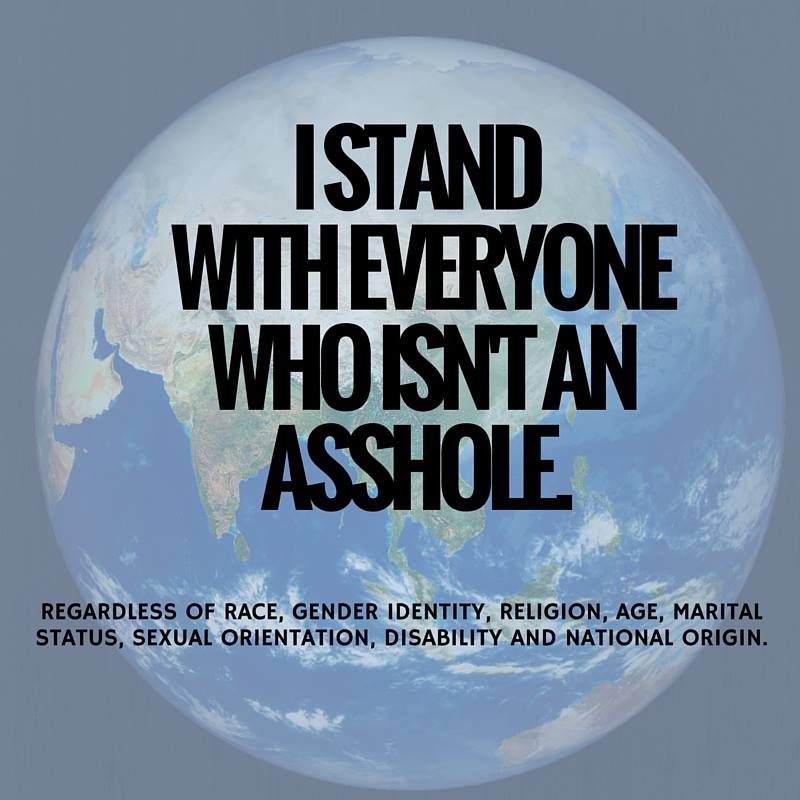
You can add "political allegiance" to that list, too.
But after reading the different stories and blogs and comments and tweets, it felt like it was time to rant a bit. So in no particular order:
#1. Canadians need to check their egos at the door. Anyone who claims that "we don't have US-style bigotry or hatred here" is living in a dream world. I see it every day. Read the comment section of any story involving Naheed Nenshi, Rachel Notley or Justin Trudeau. And it comes from all sides of the political spectrum. The keyboard warriors are alive and well here. This is no "Peace & Love" utopia and stop pretending it is. (Special note: For those who say "get a thicker skin" when it comes to politicians or media or anyone else, I have a fairly straight-forward question for you. Are you saying that we should all get used to the idea of being berated, belittled, intimidated or threatened? Because the answer should be "no." I don't care who you are, where you come from, or who crapped in your Corn Flakes, no one, and I mean NO ONE, deserves that kind of treatment, just because they're in the spotlight.)
#2. If you want to win in politics, simply trumpet something about "change." If the last Alberta election, Brexit or this US election isn't proof enough, I don't know what will be. In a weird way, I think the Occupy Movement has had a residual, albeit unknowingly profound, impact on the way everyone looks at "the establishment." We now question everything. The 99% are standing up and saying "if you don't serve us, we will gladly kick you out." That being said, people might not exactly know what that change will look like, but they know the current system is stiffing them. Which will set the bar for coming elections. If you're the Democrats looking to take power back, you'll need to be perceived as bringing about change. If you're right-wingers in Alberta, merging parties or not, you'll have to do the same. You have to be "The Agent of Change."
#3. Speaking of left-wing and right-wing politics, I have a bone to pick with the vast generalizations we're seeing (and we all know how much I love generalizations). In Alberta, just because someone is a little more right of you, doesn't mean they are a "Wildrose nutbar." And just because someone is a little more left of you, doesn't mean they are an "NDP/Libtard shill." I found some of the reaction from some Canadians to people claiming to be thinking about moving to Canada to be ridiculous. "We don't need any more Liberals here" seemed to be a common sentiment in a couple of comment sections I read. Whose to say they're Liberals? Maybe they're Republicans who felt disenfranchised by the Trump campaign. And maybe they are Liberals. When did it become so cotton-picking wrong to have a civilized debate with people from other political stripes to get a full understanding of where they're coming from. Which leads me to my next point...
#4. We gotta start listening to each other. I have friends on all sides of the political spectrum. Our conversations can get heated. They can sometimes be uncomfortable. But at the end of the day, I think we get a better understanding of why we support who we support. Somewhere along the line, we stopped listening to one another. There's a segment of the population that didn't feel like the system (under a Democratic president) was serving them well. There's also segments of the population that feel like a government led by Donald Trump won't serve their best interests either. Now, it is true that not everyone is going to be happy with every decision made. But this campaign really felt like everyone was talking into their own echo chambers. Instead of having civilized discussions about what was missing from each other's platforms, it turned into a giant game of "Marco Polo" where everyone was yelling, expecting everyone to find them in the sea of loud voices. Eventually, everyone just stopped listening. The Democrats weren't listening to those saying that the system wasn't helping them, while the Republicans weren't listening to those saying they feared the leader wasn't going to serve them. And the more everyone pushed, the harder everyone dug in.
#5. Everyone dug into their belief that their candidate was less corrupt than the other. And the trouble was, I don't think people realized that while they might have been standing for the good in their candidate, they were also standing for the bad. To get something, you had to give up something else. The candidates had a lot of baggage, which led to questions about how morally, politically, socially or fiscally bankrupt (or any combination) you were willing to be. It's no wonder the undecided voters had a hard time figuring out where to go. It's a dilemma that puts me to mind of this scene from The Newsroom, and how the two-party system is a little harder to navigate with shades of grey.
Don't get me wrong. This isn't a support piece for either candidate. Everyone has some soul-searching to do. Democrats, Republicans, pollsters, the media, even Americans. But it's Americans who cast their ballots, therefore they have spoken.. We might not like the outcome, but in a democracy, we have a winner and a loser. We can continue to be as divided as we are.
Or (and at risk of sounding like a hippie)...
We can learn from this experience and promise ourselves never to let this happen again. We're supposed to be part of a civilized, democratic world. We don't always have to agree. In fact, we need strong opposition in our political systems. But make sure it's effective opposition. Don't oppose for the sake of opposing or because "the other guys" like something. Give credit where credit is due. Agree when it makes sense for everyone. Come up with reasonable solutions to problems. Be good to one another instead of looking at our differences as a reason to hate. And govern the same way.
"I stand with everyone who isn't an asshole. Regardless of race, gender identity, religion, age, marital status, sexual orientation, disability and national origin."
You can add "political allegiance" to that list, too.
Monday, October 31, 2016
Shiny Things in the Vending Machine
Why would anyone want to be a politician?
I know it seems like a really simple question. And I know those in political lives right now would answer this in the most Miss America way they possibly could.
"I want to bring positive change to the world."
"I want to serve my community."
"We deserve leadership."
All lovely platitudes. But it kind of feels like hogwash nowadays, doesn't it? Sure, there are a few out there who are doing a great job of being public servants. They represent their constituents well, and they're about as "open book" as you can get.
But it feels like the good apples are being ruined by the bad ones. And it's making it tougher for the good apples to want to even get in the basket.
Think about it. Would you be willing to open up your entire life for the world to see?
You would be subjecting your family and friends to an insane amount of scrutiny. Your husband or wife will be judged for everything they did or do, how they look and how they interact with others. Your children will be put into an unwarranted spotlight. As they get older, they will be put under the microscope for every social situation they find themselves in. Your friends will have to be extra-careful to make sure they don't post anything on social media that could lead to some kind of controversy, even if it's as simple as you having a beer.
Then you get into the partisanship aspect. You will have your values and beliefs ripped apart. You could be the most saintly person on the face of the planet, but if you're not of a certain religious background, you will be torn to shreds by some followers of other faiths. Support same-sex marriage? Good luck with those who don't support it (they'll wish you a lifetime of damnation). Question gun control? They'll think you want to take away their guns (even if all you want is to end school shootings). Support the oilsands? The environmentalists will picket outside your home and office in a heartbeat (even though the hypocrisy they show is always so evident). The insanity is going to come from all sides. So buckle up, kid!
And don't even get me started on ideas and change. Have a good idea? Park it. Because someone will think you're targeting them, or that you're threatening their way of life. And make sure your ideas are simple. Because if people have to think, they will revolt because it feels like you're talking down to them. They want your ideas in 140 characters or less. So get practicing.
Many people have asked the question about "where have all the good candidates gone?" The joke with the American election, for example, has been about how there are 330-million people and these are the two best candidates to run the United States?
Is this an accident?
I have a feeling the answer is no. Most of the "good" candidates (the ones of sane mind and best intentions) are in hiding. Why? Ask yourself the above questions about what you'd be willing to sacrifice.
But ask yourself, as a voter, about what you've come to expect from politicians. Many people expect the absolute worst. They think they need to be some combination of morally corrupt, fiscally incompetent and/or reality-deprived. And if they can't find it on the cover of the book, don't worry, they will go digging for it. They will find anything, no matter how minuscule, to throw you under the bus. Why? There's this nagging feeling that it's "too good to be true", and they don't want to be disappointed later. It's a different kind of abusive relationship.
Maybe I'm an idealist, but it feels like there was a time when we expected more. We looked for the good in our candidates. We looked for people who had a vision, who could get things done and who could work with others. Even the opposition.
But somewhere along the way, we got lost. Instead of having visions and working together, opposition politicians scream from the rooftops about how they've been hard done by and how only THEY can fix it. They campaign on "change" then they enter office and do the exact same thing (or some minor variation) of what they campaigned against. They don't offer up their own ideas, they simply cry foul. I once joked that one politician could say "the sky is blue" and opposition politicians would yell back "screw you, the sky is red!" It happens at all levels, especially in the party system. They oppose for the sake of opposing because their partisanship tells them to. Who needs good policy and ideas when you can simply do all you can to discredit your opposition? It's no wonder it takes forever for ideas to come to fruition.
And it's no wonder people are turned off politics. They see all the yelling and screaming. They see all the scandals and discourse. And they see who they are voting for. They don't like it.
Maybe we need to hit rock-bottom. Maybe we need to elect the worst of the worst. Maybe then we'll start looking for the best in candidates and the best candidates. Maybe then we'll start seeing some of the best coming forward, all with well-thought out policy ideas and plans. Maybe they'll even have a shred of moral decency. Maybe they won't come in with a bunch of vested interests outside of serving the common good.
We should be taking this "democracy" thing seriously. Instead, we're mocking it. We've seemingly allowed ourselves to devolve into a giant junior high school council election, where only the well-known kids get voted in. It doesn't matter if they're promising nothing or they're promising soda machines in every classroom and five recesses a day. They might be bullies or have an IQ of a stick. But they're popular.
Meanwhile, the smart kids in the corner of the classroom, with all the good ideas in the world and decent human compasses, are sitting on the sidelines, knowing they stand a snowball's chance in you-know-where of winning this thing.
It's not that the vote is rigged.
It's just that no one is taking them seriously, because the electorate is distracted by shiny things in the vending machine.
I know it seems like a really simple question. And I know those in political lives right now would answer this in the most Miss America way they possibly could.
"I want to bring positive change to the world."
"I want to serve my community."
"We deserve leadership."
All lovely platitudes. But it kind of feels like hogwash nowadays, doesn't it? Sure, there are a few out there who are doing a great job of being public servants. They represent their constituents well, and they're about as "open book" as you can get.
But it feels like the good apples are being ruined by the bad ones. And it's making it tougher for the good apples to want to even get in the basket.
Think about it. Would you be willing to open up your entire life for the world to see?
You would be subjecting your family and friends to an insane amount of scrutiny. Your husband or wife will be judged for everything they did or do, how they look and how they interact with others. Your children will be put into an unwarranted spotlight. As they get older, they will be put under the microscope for every social situation they find themselves in. Your friends will have to be extra-careful to make sure they don't post anything on social media that could lead to some kind of controversy, even if it's as simple as you having a beer.
Then you get into the partisanship aspect. You will have your values and beliefs ripped apart. You could be the most saintly person on the face of the planet, but if you're not of a certain religious background, you will be torn to shreds by some followers of other faiths. Support same-sex marriage? Good luck with those who don't support it (they'll wish you a lifetime of damnation). Question gun control? They'll think you want to take away their guns (even if all you want is to end school shootings). Support the oilsands? The environmentalists will picket outside your home and office in a heartbeat (even though the hypocrisy they show is always so evident). The insanity is going to come from all sides. So buckle up, kid!
And don't even get me started on ideas and change. Have a good idea? Park it. Because someone will think you're targeting them, or that you're threatening their way of life. And make sure your ideas are simple. Because if people have to think, they will revolt because it feels like you're talking down to them. They want your ideas in 140 characters or less. So get practicing.
Many people have asked the question about "where have all the good candidates gone?" The joke with the American election, for example, has been about how there are 330-million people and these are the two best candidates to run the United States?
Is this an accident?
I have a feeling the answer is no. Most of the "good" candidates (the ones of sane mind and best intentions) are in hiding. Why? Ask yourself the above questions about what you'd be willing to sacrifice.
But ask yourself, as a voter, about what you've come to expect from politicians. Many people expect the absolute worst. They think they need to be some combination of morally corrupt, fiscally incompetent and/or reality-deprived. And if they can't find it on the cover of the book, don't worry, they will go digging for it. They will find anything, no matter how minuscule, to throw you under the bus. Why? There's this nagging feeling that it's "too good to be true", and they don't want to be disappointed later. It's a different kind of abusive relationship.
Maybe I'm an idealist, but it feels like there was a time when we expected more. We looked for the good in our candidates. We looked for people who had a vision, who could get things done and who could work with others. Even the opposition.
But somewhere along the way, we got lost. Instead of having visions and working together, opposition politicians scream from the rooftops about how they've been hard done by and how only THEY can fix it. They campaign on "change" then they enter office and do the exact same thing (or some minor variation) of what they campaigned against. They don't offer up their own ideas, they simply cry foul. I once joked that one politician could say "the sky is blue" and opposition politicians would yell back "screw you, the sky is red!" It happens at all levels, especially in the party system. They oppose for the sake of opposing because their partisanship tells them to. Who needs good policy and ideas when you can simply do all you can to discredit your opposition? It's no wonder it takes forever for ideas to come to fruition.
And it's no wonder people are turned off politics. They see all the yelling and screaming. They see all the scandals and discourse. And they see who they are voting for. They don't like it.
Maybe we need to hit rock-bottom. Maybe we need to elect the worst of the worst. Maybe then we'll start looking for the best in candidates and the best candidates. Maybe then we'll start seeing some of the best coming forward, all with well-thought out policy ideas and plans. Maybe they'll even have a shred of moral decency. Maybe they won't come in with a bunch of vested interests outside of serving the common good.
We should be taking this "democracy" thing seriously. Instead, we're mocking it. We've seemingly allowed ourselves to devolve into a giant junior high school council election, where only the well-known kids get voted in. It doesn't matter if they're promising nothing or they're promising soda machines in every classroom and five recesses a day. They might be bullies or have an IQ of a stick. But they're popular.
Meanwhile, the smart kids in the corner of the classroom, with all the good ideas in the world and decent human compasses, are sitting on the sidelines, knowing they stand a snowball's chance in you-know-where of winning this thing.
It's not that the vote is rigged.
It's just that no one is taking them seriously, because the electorate is distracted by shiny things in the vending machine.
Thursday, October 27, 2016
Here's The Trouble...
"The right-wing is just a bunch of crazy, bigoted morons!"
"The left-wing is so afraid of offending anyone!"
"We need to clean out police departments because they're filled with corruption!"
"Teachers are lazy!"
"The media is biased!"
Something's been eating at me lately. I wasn't exactly sure what it was, but it's finally dawned on me, particularly when you see the last five statements read together.
Generalizations need to stop!
Somehow, some way, we've allowed ourselves to make sure we group everything we hate into one finite group without ever needing to question that group. Let me explain with the first example.
We all know the right-wing in politics is represented by Conservatives (in Canada) or Republicans (in the USA). Anyone who opposes these viewpoints is automatically labeled in some way (depends on the person), but all in the same way. So if one Conservative is also a meat eater, than all Conservatives are meat eaters. And that's not necessarily true. So why is that we allow the generalizations to be made on a bigger scale, like that if you're a Conservative but also anti-gay, then that must mean that all Conservatives are anti-gay. That's obviously not true, but yet that painting is still being shown.
Let's move to groups like police, teachers and nurses. Some people will proclaim that they are "lazy". But are they?
Not even a little bit.
Look at police and how they're characterized as being ruthless, gun-toting thugs. Is that true of all?
Absolutely not.
And how about that dastardly media? As I've pointed out in the past, there is no "the media". It's not like there are these grand meetings featuring gold name plates and caviar, where reporters and anchors determine what kinds of stories we are going to be feeding to the masses. "The media" is simply code for those particular outlets that you don't agree with but feel the need to lump together.
Here's the deal: you're letting a bad apple or two ruin your perception of how the group (generally) acts as a whole.
And if you don't believe me on this, then let me throw another one to you: all sports reporters are cheerleaders. Sounds outlandish doesn't it? Yet, there are those who are labeled as cheerleaders by some followers. So in theory, that original statement should hold true.
Here's another one: office workers are lazy. Of course, that's not true either. But why is it okay not to say that, when some people think it's okay to call rig workers "buffoons who couldn't get through high school"?
And don't say any of these generalizations aren't made, because they are. I see it on a regular basis. Different sides to different debates, battling it out over who can be pound their chest and hold ultimate supremacy over each other. It's hogwash. Absolute and utter hogwash.
Because the world isn't black and white. No matter how hard you try.
There are fiscal conservatives who aren't bigots.
There are social progressives who want their tax money watched carefully.
There are good police officers who serve their communities well.
There are great teachers who are trying to make the world better for kids.
And there are reporters and media outlets out there acting as a public service for information.
I'm willing to bet some of these good people are just dying to get their stories out there. They hate being characterized in the same light as the idiotic generalizations that follow them around day after day.
I'm not saying there isn't rot in the world and it doesn't need to have the light shine down on it. But what I am saying is that the rot shouldn't be allowed to infect everything, including our judgment, to allow for generalizations to bury the good happening out there.
Because there is good in the world. You just need to start looking for it.
"The left-wing is so afraid of offending anyone!"
"We need to clean out police departments because they're filled with corruption!"
"Teachers are lazy!"
"The media is biased!"
Something's been eating at me lately. I wasn't exactly sure what it was, but it's finally dawned on me, particularly when you see the last five statements read together.
Generalizations need to stop!
Somehow, some way, we've allowed ourselves to make sure we group everything we hate into one finite group without ever needing to question that group. Let me explain with the first example.
We all know the right-wing in politics is represented by Conservatives (in Canada) or Republicans (in the USA). Anyone who opposes these viewpoints is automatically labeled in some way (depends on the person), but all in the same way. So if one Conservative is also a meat eater, than all Conservatives are meat eaters. And that's not necessarily true. So why is that we allow the generalizations to be made on a bigger scale, like that if you're a Conservative but also anti-gay, then that must mean that all Conservatives are anti-gay. That's obviously not true, but yet that painting is still being shown.
Let's move to groups like police, teachers and nurses. Some people will proclaim that they are "lazy". But are they?
Not even a little bit.
Look at police and how they're characterized as being ruthless, gun-toting thugs. Is that true of all?
Absolutely not.
And how about that dastardly media? As I've pointed out in the past, there is no "the media". It's not like there are these grand meetings featuring gold name plates and caviar, where reporters and anchors determine what kinds of stories we are going to be feeding to the masses. "The media" is simply code for those particular outlets that you don't agree with but feel the need to lump together.
Here's the deal: you're letting a bad apple or two ruin your perception of how the group (generally) acts as a whole.
And if you don't believe me on this, then let me throw another one to you: all sports reporters are cheerleaders. Sounds outlandish doesn't it? Yet, there are those who are labeled as cheerleaders by some followers. So in theory, that original statement should hold true.
Here's another one: office workers are lazy. Of course, that's not true either. But why is it okay not to say that, when some people think it's okay to call rig workers "buffoons who couldn't get through high school"?
And don't say any of these generalizations aren't made, because they are. I see it on a regular basis. Different sides to different debates, battling it out over who can be pound their chest and hold ultimate supremacy over each other. It's hogwash. Absolute and utter hogwash.
Because the world isn't black and white. No matter how hard you try.
There are fiscal conservatives who aren't bigots.
There are social progressives who want their tax money watched carefully.
There are good police officers who serve their communities well.
There are great teachers who are trying to make the world better for kids.
And there are reporters and media outlets out there acting as a public service for information.
I'm willing to bet some of these good people are just dying to get their stories out there. They hate being characterized in the same light as the idiotic generalizations that follow them around day after day.
I'm not saying there isn't rot in the world and it doesn't need to have the light shine down on it. But what I am saying is that the rot shouldn't be allowed to infect everything, including our judgment, to allow for generalizations to bury the good happening out there.
Because there is good in the world. You just need to start looking for it.
Friday, October 14, 2016
"Bad News" vs. "Good News"
I hear it all the time.
"Why can't we have more good in newscasts?"
It's certainly something that's hard to ignore. We are constantly bombarded with death, destruction, controversy and scandal. Some people have decided to tune it out, and I don't necessarily blame them. It's admittedly hard on reporters and others in "the news" to deal with the constant negativity, I can only imagine what it's like for someone outside of that circle to deal with on a daily basis. The result? An uptick in the number of "good news" stories being passed around.
It begs a really interesting question in the grand scheme of things: what is a good mix of "bad news" and "good news"?
You see, not everyone likes good news. In fact, some detest it. Whenever you see a good news story mixed into the run, you will see some pretty normal reactions. "This isn't news", "must be a slow news day" or "there are bigger stories you should be reporting on." It happens EVERY time. So, as a reporter, you're a little gun-shy to do those kinds of stories.
The other interesting reaction happens when it comes to organizations that don't necessarily get positive stories. Let's use police as an example. Every so often, you see the stories about officers doing good things. A reporter will cover that story, but then get lambasted for playing "public relations" for police, trying to cover up whatever scandal might be out there. Same goes for politicians. Heck, even when we do feel good stories about a birth at the Calgary Zoo, some people will complain about how it's covering up the wrongs happening at the Zoo. It's a no-win proposition.
I've had this conversation with a few different people, both in the industry and out of it, because I've always believed in having a wide-ranging discussion about these kinds of things, in hopes of getting a better-rounded product for my listeners. The challenge is finding balance. You can't ignore the bad happening in the world, but you also can't shy away from the good.
Is the old adage of "if it bleeds, it leads" dead? Does sex still sell? I remember being told that good news just doesn't work. No one pays attention to it. I'm curious, in the day-and-age of the internet, if that is all changing.
I'm also curious about the societal impact of having more "good news"? Would people be more-inclined to do good things if they knew there was good out there in the world? Would people feel better about the world if they had better news around them? Or would they simply sluff it off after a while, saying it's "not really news" or that it's "propaganda for those with something to hide"? Then, of course, that fuels that "mainstream media" hatred that seems to be making the rounds.
Don't get me wrong. I still believe in the power of investigative reporting. Accountability is extremely important and should be viewed as such. We can't not report on the bad things around our communities and around our world either.
But the question still remains: is there room for some good news in the world as well?
"Why can't we have more good in newscasts?"
It's certainly something that's hard to ignore. We are constantly bombarded with death, destruction, controversy and scandal. Some people have decided to tune it out, and I don't necessarily blame them. It's admittedly hard on reporters and others in "the news" to deal with the constant negativity, I can only imagine what it's like for someone outside of that circle to deal with on a daily basis. The result? An uptick in the number of "good news" stories being passed around.
It begs a really interesting question in the grand scheme of things: what is a good mix of "bad news" and "good news"?
You see, not everyone likes good news. In fact, some detest it. Whenever you see a good news story mixed into the run, you will see some pretty normal reactions. "This isn't news", "must be a slow news day" or "there are bigger stories you should be reporting on." It happens EVERY time. So, as a reporter, you're a little gun-shy to do those kinds of stories.
Follower: "I'm tired of politics. Post some good news!"
— Joe McFarland (@JoeMcFarland) October 4, 2016
Posts good news.
Others: "This isn't news" or "must be a slow news day."
Ugh. #yyc
The other interesting reaction happens when it comes to organizations that don't necessarily get positive stories. Let's use police as an example. Every so often, you see the stories about officers doing good things. A reporter will cover that story, but then get lambasted for playing "public relations" for police, trying to cover up whatever scandal might be out there. Same goes for politicians. Heck, even when we do feel good stories about a birth at the Calgary Zoo, some people will complain about how it's covering up the wrongs happening at the Zoo. It's a no-win proposition.
I've had this conversation with a few different people, both in the industry and out of it, because I've always believed in having a wide-ranging discussion about these kinds of things, in hopes of getting a better-rounded product for my listeners. The challenge is finding balance. You can't ignore the bad happening in the world, but you also can't shy away from the good.
Is the old adage of "if it bleeds, it leads" dead? Does sex still sell? I remember being told that good news just doesn't work. No one pays attention to it. I'm curious, in the day-and-age of the internet, if that is all changing.
I'm also curious about the societal impact of having more "good news"? Would people be more-inclined to do good things if they knew there was good out there in the world? Would people feel better about the world if they had better news around them? Or would they simply sluff it off after a while, saying it's "not really news" or that it's "propaganda for those with something to hide"? Then, of course, that fuels that "mainstream media" hatred that seems to be making the rounds.
Don't get me wrong. I still believe in the power of investigative reporting. Accountability is extremely important and should be viewed as such. We can't not report on the bad things around our communities and around our world either.
But the question still remains: is there room for some good news in the world as well?
Saturday, October 1, 2016
What If We're All Wrong...
Every so often, I get phone
calls in the newsroom from people who take issue with how certain
stories are written or are perceived to have been written (because let's
face it, some people hear what they want to hear).
Sometimes, they are
ridiculous phone calls that I try to end in the first couple of
minutes. The accusations can go from fairly tame to downright
aggressive. And that's fine. Everyone has their right to an opinion
and I can handle it. In all of those
cases, I present the facts, as they're laid out, and a reasoned
discussion on how and why a story was covered. I'd say 99% of those who
call irritated hang up the phone feeling a little less upset and, at
the very least, a little more enlightened.
But once in a while, I get a
phone call from a listener who makes me think a little. Such was the
case today with a gentleman who wanted to talk about the state of the
economy in Alberta. He didn't want to pin blame on anyone in
particular, but felt like
Albertans should all be taking responsibility for where we're at now.
He seemed to be of the
mindset that we missed opportunities years ago in trying to diversify
our economy. Whether it was in technology, manufacturing or some other
industry, we seemed to miss the boat because we had the blinders on,
thinking that we could
live off the avails of oil and gas forever.
But on the flipside, he was
also unimpressed that we're now seemingly trying to make up for lost
time by diving head-first into a number of different "possible" sectors,
while throwing our "bread and butter" under the bus. He compared it to
throwing mud
against a wall to see what will stick.
Then he brought up the most
interesting point of all: what is Alberta going to look like in 50
years? Will it be all oil and gas? Will it be solar and wind? Will we
discover some other revenue stream that will keep this province humming
along?
I didn't have the answer to
him, but I then asked him if he's heard any vision on that topic from
anyone. And that's the point he wanted to make. He went on to say that
while politicians and political watchers stumble over themselves trying
to pin the
blame on others, we haven't really heard anything about what a future
Alberta could look like, with or without oil and gas.
It was a very interesting
conversation, and as I sit here and dissect it, it made me think of a
few questions that I think we should be pondering:
#1. Are we afraid of economic diversification, or are we afraid of the
potential of walking into an unknown world, away from oil and gas?
#2. What does this mystical creature known as "economic diversification" look like, and how does it pertain to Alberta?
#3. Should we be willing to throw the oil and gas industry out with the
bath water while we go searching for this mystical creature, or should
we trying to make it fluorish while we go on our expedition?
#4. What if those who think we can shut off the oil and gas taps right away are wrong?
Personally, one of the challenges we're having with this discussion is that we're trying to have it 140-characters at a time. It's an issue I think with many different debates, to be honest. We should be opening up the dialogue and not be afraid to ask some pretty point questions, demanding well-thought out answers.
We owe it to ourselves.
Thursday, September 15, 2016
What If We Tried This...
Every so often, I get a little poli-nerdy.
It comes from a fascination with political systems and math. As I've become more entrenched in the political world as a reporter, I've been able to see a number of elections transpire with a variety of outcomes. And after every election, there's always talk about electoral reform.
You see, whenever someone loses an election, there's an instant belief that the numbers don't make sense. How can a party garner 35-40% of popular support, command 80% of the legislature or House of Commons? This is nothing new to the game, as political parties from both sides of the spectrum have cried foul over the representation not necessarily mirroring what the popular vote says.
So what would electoral reform look like? Is it representation-by-population? Is it a set number of delegates from each province and territory (ie 5 for each)? Even beyond that is the argument over how to get more people out to vote.
I'm going to propose something a little crazy. What if we did a mish-mash of the different kinds of systems out there?
Here's what I'm thinking: each party runs in an election with a "depth chart". In Alberta, you would have your leader, deputy leader, finance minister, agriculture minister, justice minister, and on and on. In federal politics, same idea, with maybe a BC Minister, Alberta Minister, etc, to go along with your standard ministries (and maybe you want to give some more than one portfolio, so the justice minister is also Manitoba minister). This gives the electorate an understanding of how big your cabinet would be, where your strengths are, what you think will be important portfolios, and that kind of thing.
Then come election day, whatever percentage of the vote you get is how many seats you end up receiving. So in Alberta, we have 87 seats. Let's say the top percentage vote is 43%, so you will end up with 37 seats. You end up with 8% of the vote, you get 7 seats. So each party will pick their best people to sit in those seats while the rest can work as advisers or whatever the case may be.
Add in fixed election dates and recall legislation and I think you make the case for forcing parties to work together for the greater good. The fixed election dates mean you can't have opposition parties with non-confidence motions forcing another election, and utilize recall legislation for the entire group, so if we, as the electorate, feel we're not being served, we can toss those not getting along.
I know the one argument against this idea will be that we're essentially taking local representation away. And while I don't necessarily disagree, how often have we seen it where local MLAs or MPs are nothing more than puppets for the party anyways? I know of politicians who sat for years or even decades without doing anything of real substance, never sat as cabinet ministers, yet continued to get voted in because they were with the governing party. What if this new kind of government would force governments to hear concerns of all Albertans (or Canadians), rather than listen to only those in their own jurisdictions, so that they can get a "full picture" of each of their decisions? Interestingly enough, I do believe in local representation. But I also vote based on who will be the best representative for me and for the people in my riding. As weird as it sounds, I'd rather have my representative be effective in opposition, rather than be a lap-dog with the governing party.
I'm not pretending to have all the answers or to understand all the ins and outs of how this system would totally work. But maybe this can be a bit of a discussion-starter when it comes to thinking outside the box, rather than believing that the system can only work in one of two or three ways.
Because the definition of insanity is doing the same thing over and over and over again while expecting a different result. And that's sort of how it feels when it comes to election reform.
It comes from a fascination with political systems and math. As I've become more entrenched in the political world as a reporter, I've been able to see a number of elections transpire with a variety of outcomes. And after every election, there's always talk about electoral reform.
You see, whenever someone loses an election, there's an instant belief that the numbers don't make sense. How can a party garner 35-40% of popular support, command 80% of the legislature or House of Commons? This is nothing new to the game, as political parties from both sides of the spectrum have cried foul over the representation not necessarily mirroring what the popular vote says.
So what would electoral reform look like? Is it representation-by-population? Is it a set number of delegates from each province and territory (ie 5 for each)? Even beyond that is the argument over how to get more people out to vote.
I'm going to propose something a little crazy. What if we did a mish-mash of the different kinds of systems out there?
Here's what I'm thinking: each party runs in an election with a "depth chart". In Alberta, you would have your leader, deputy leader, finance minister, agriculture minister, justice minister, and on and on. In federal politics, same idea, with maybe a BC Minister, Alberta Minister, etc, to go along with your standard ministries (and maybe you want to give some more than one portfolio, so the justice minister is also Manitoba minister). This gives the electorate an understanding of how big your cabinet would be, where your strengths are, what you think will be important portfolios, and that kind of thing.
Then come election day, whatever percentage of the vote you get is how many seats you end up receiving. So in Alberta, we have 87 seats. Let's say the top percentage vote is 43%, so you will end up with 37 seats. You end up with 8% of the vote, you get 7 seats. So each party will pick their best people to sit in those seats while the rest can work as advisers or whatever the case may be.
Add in fixed election dates and recall legislation and I think you make the case for forcing parties to work together for the greater good. The fixed election dates mean you can't have opposition parties with non-confidence motions forcing another election, and utilize recall legislation for the entire group, so if we, as the electorate, feel we're not being served, we can toss those not getting along.
I know the one argument against this idea will be that we're essentially taking local representation away. And while I don't necessarily disagree, how often have we seen it where local MLAs or MPs are nothing more than puppets for the party anyways? I know of politicians who sat for years or even decades without doing anything of real substance, never sat as cabinet ministers, yet continued to get voted in because they were with the governing party. What if this new kind of government would force governments to hear concerns of all Albertans (or Canadians), rather than listen to only those in their own jurisdictions, so that they can get a "full picture" of each of their decisions? Interestingly enough, I do believe in local representation. But I also vote based on who will be the best representative for me and for the people in my riding. As weird as it sounds, I'd rather have my representative be effective in opposition, rather than be a lap-dog with the governing party.
I'm not pretending to have all the answers or to understand all the ins and outs of how this system would totally work. But maybe this can be a bit of a discussion-starter when it comes to thinking outside the box, rather than believing that the system can only work in one of two or three ways.
Because the definition of insanity is doing the same thing over and over and over again while expecting a different result. And that's sort of how it feels when it comes to election reform.
Monday, September 12, 2016
Take Care Of Yourself
It doesn't matter who you are, you need to decompress sometimes.
That's the lovely thing about summer. Typically it's the time of the year everyone takes a week or two off. You get out of the house a little more, maybe take off from the office an hour early here and there, in hopes of escaping, even for a little while.
As reporters, we sometimes forget to do that. In a sense, we're addicted to information. We want to keep our audiences informed and we don't want to miss anything. I've admitted before that going on vacation used to be a little weird. But in this world of constant communication, it's really important to disconnect.
What I find interesting is that we spend so much time focusing on mental health issues and discussions in media, yet it's not really something we talk about for ourselves, as an industry. It's one thing to say "time to disconnect" during vacations. It's another to start talking about disconnecting after major emotional or psychological stories, or just from the simple day-to-day stories we cover.
Here in Calgary, many were glued to their local news outlets, hoping to hear the latest about five-year-old Taliyah Marsman. Her mother, Sara Baillie, was found dead in their northwest Calgary home in July, leading to an Amber Alert for the little girl. There was so much mystery around her disappearance, and it quickly became a national story. Everyone was hoping for the best, but unfortunately the worst was realized when her body was found outside city limits a few days later.
It was an emotional roller-coaster for everyone, including those covering the story, as they spoke with family, friends and others, who were also holding out hope. The raw emotion you witness first-hand as a reporter can be extremely intense and this was no exception. As I was being interviewed by one of our national hosts during the search, I realized just how often this kind of story had happened in our listening area. There was the Nathan O'Brien case, where he and his grandparents, Alvin and Kathy Liknes, disappeared from Calgary. Their bodies were never found, but murder charges were eventually laid. There was the Hailey Dunbar-Blanchette case, where she and her father were killed in Coleman. Murder charges were eventually laid there as well. You had one with a happier ending a few years earlier with the disappearance of Kienan Hebert in Sparwood. He was returned to his home a few days after the search began, with a man being charged with kidnapping.
All were high-profile and all were emotionally-charged. I know many people who shed tears over these cases. And I know many reporters who did the same thing. As much as some people think we're "vultures" with no emotion, I would say for most here in Calgary, it's untrue. We do take our work home with us sometimes.
Many of us talk with friends and family about the stories we cover. And it's not always good news. I'm lucky that way. I have a great support system of family and friends who let me vent when I need to, or simply let me unwind. I have outlets like hosting hockey games which allows me to find balance in my life. But I know not everyone has that. After what's been a busy summer, then having this past week off to let loose, I wanted to write something to you. You might be a reporter friend, a family member of a reporter or simply someone interested in media.
My message here is simple: don't be afraid to disconnect and unwind. Find something that allows you to "get away", even if it is for a few hours. It will do you a world of good when the world only wants to throw you the bad.
Thursday, July 14, 2016
#BlameTheMedia
I've tried really hard to stay out of the debates about "The Media" or "The Mainstream Media", but there comes a point where we need to start standing up for ourselves. So I guess here we are.
This has actually been percolating in my mind for a few weeks now, it's just been a challenge to find the right way to word it without sounding like a jaded, old "traditional media" guy who obviously still has a horse in the race. But as I've watched the coverage of big local news stories and big international stories alike, I can't help but feel like something needs to be said.
Recently, I received a text message from a former colleague about challenges she was facing in getting an interview about a local issue. I jokingly bugged her about how no one wanted to talk to her because she was part of "the media". That's part of the trouble I suppose, is that we're now treating it like it's a joke, when it's really not.
Whether this is a self-induced problem or not is an interesting debate, because it is and it isn't. Some outlets pander to the ratings. Others over-use the term "breaking news". Others show biases. It's a bunch of different issues that have seemingly eroded the public's trust in media. On the other side though, we have a TON of reporters who work their tails off day in and day out, bringing great stories and shedding light on all sorts of issues. Yet that hard work and dedication seems to get downplayed.
Just in the last day or so, I became involved in a bit of a Twitter debate over media and one commenter stated "We're witnessing the death rattle of the MSM, what a time to be alive!" It also featured "thumbs up" and "clapping" emojis. Is this really what we should be applauding? Are we really applauding a less-informed and less-educated society?
I'm not trying to be overly-dramatic here. But there seems to be this thought process that "citizen journalists" or social media will be able to do all of the informing. Here's the point being missed: where do you think those original stories on social media come from? Especially when it comes to local stories. Who in the social media sphere is covering city council on a regular basis? Who in the social media sphere is going to report on crime and sit through days and weeks of criminal court proceedings? Who in the social media sphere is able to hold politicians, police, school boards and others to account by developing contacts, investigating stories, asking questions of the appropriate people and then bringing those stories to you in a factual way?
Don't get me wrong. I actually believe there's a place in this world for the online media outlets that are starting to pop up. The thing is: they are catering to a very specific audience. They have their own agendas and I say "good on them." They are filling a void, as witnessed by their followings. But you have to ask yourself a question: what stories aren't they telling? Maybe the "mainstream media" isn't covering the stories that really matter to you, but maybe the "online media" isn't covering the stories that really matter to others. To me, writing either one of them off is foolish. To me, there's a place for both.
The other issue I want to bring up is the arguments about paywalls and advertising. Somewhere along the line, we became obsessed with the idea that news is free. It's not. It takes time and resources to put together stories and newscasts and newspapers. It's not just reporters but also editors and photographers and producers to make sure the product is ready for the public's consumption. Stories don't just pop up out of thin air.
I don't have all (or maybe even any) of the answers in how to increase readership/listenership/viewership or how to bring revenues back up. What I do know is that we've seemingly entered this vicious circle where revenues are down, which has led to layoffs, which has led to fewer stories, which has led to an erosion of trust, which has led to doubt about reach, which has led to more declines in revenues, and on and on it goes.
What I do know is that I'm not willing to stand by and accept it. We have to stop loathing in self-pity and start standing up for ourselves and the work that we're doing. Does this mean we need to be more focused on the kinds of stories we do and stop trying to be "everything to everyone"? Maybe. Does this mean marketing ourselves a different way? Maybe. Do we need to start capitalizing on what makes us integral to the communities that we serve? Absolutely. And maybe we start by answering those first two questions.
We've been spinning our tires for far too long, trying to think of ways to prove to the audience that we're still relevant in today's marketplace. Maybe it's time to make the rubber hit the road. I think it starts with getting rid of the "superiority" complex (that we're essential in this day and age), understanding why the perceptions out there about "mainstream media" even exist, then addressing those perceptions in a way that informs but busts those perceptions.
Because if we keep going down this same path, we're only delaying the inevitable. Those who think the "death rattle" will actually be proven right. But I don't think the world will be a better place for it. People will quickly realize just how much local news will be missing, because those stories aren't being fed from traditional media to the social media. It's not that the stories don't exist. It's just that they won't be told.
Then who's going to be able to #BlameTheMedia?
This has actually been percolating in my mind for a few weeks now, it's just been a challenge to find the right way to word it without sounding like a jaded, old "traditional media" guy who obviously still has a horse in the race. But as I've watched the coverage of big local news stories and big international stories alike, I can't help but feel like something needs to be said.
Recently, I received a text message from a former colleague about challenges she was facing in getting an interview about a local issue. I jokingly bugged her about how no one wanted to talk to her because she was part of "the media". That's part of the trouble I suppose, is that we're now treating it like it's a joke, when it's really not.
Whether this is a self-induced problem or not is an interesting debate, because it is and it isn't. Some outlets pander to the ratings. Others over-use the term "breaking news". Others show biases. It's a bunch of different issues that have seemingly eroded the public's trust in media. On the other side though, we have a TON of reporters who work their tails off day in and day out, bringing great stories and shedding light on all sorts of issues. Yet that hard work and dedication seems to get downplayed.
Just in the last day or so, I became involved in a bit of a Twitter debate over media and one commenter stated "We're witnessing the death rattle of the MSM, what a time to be alive!" It also featured "thumbs up" and "clapping" emojis. Is this really what we should be applauding? Are we really applauding a less-informed and less-educated society?
I'm not trying to be overly-dramatic here. But there seems to be this thought process that "citizen journalists" or social media will be able to do all of the informing. Here's the point being missed: where do you think those original stories on social media come from? Especially when it comes to local stories. Who in the social media sphere is covering city council on a regular basis? Who in the social media sphere is going to report on crime and sit through days and weeks of criminal court proceedings? Who in the social media sphere is able to hold politicians, police, school boards and others to account by developing contacts, investigating stories, asking questions of the appropriate people and then bringing those stories to you in a factual way?
Don't get me wrong. I actually believe there's a place in this world for the online media outlets that are starting to pop up. The thing is: they are catering to a very specific audience. They have their own agendas and I say "good on them." They are filling a void, as witnessed by their followings. But you have to ask yourself a question: what stories aren't they telling? Maybe the "mainstream media" isn't covering the stories that really matter to you, but maybe the "online media" isn't covering the stories that really matter to others. To me, writing either one of them off is foolish. To me, there's a place for both.
The other issue I want to bring up is the arguments about paywalls and advertising. Somewhere along the line, we became obsessed with the idea that news is free. It's not. It takes time and resources to put together stories and newscasts and newspapers. It's not just reporters but also editors and photographers and producers to make sure the product is ready for the public's consumption. Stories don't just pop up out of thin air.
I don't have all (or maybe even any) of the answers in how to increase readership/listenership/viewership or how to bring revenues back up. What I do know is that we've seemingly entered this vicious circle where revenues are down, which has led to layoffs, which has led to fewer stories, which has led to an erosion of trust, which has led to doubt about reach, which has led to more declines in revenues, and on and on it goes.
What I do know is that I'm not willing to stand by and accept it. We have to stop loathing in self-pity and start standing up for ourselves and the work that we're doing. Does this mean we need to be more focused on the kinds of stories we do and stop trying to be "everything to everyone"? Maybe. Does this mean marketing ourselves a different way? Maybe. Do we need to start capitalizing on what makes us integral to the communities that we serve? Absolutely. And maybe we start by answering those first two questions.
We've been spinning our tires for far too long, trying to think of ways to prove to the audience that we're still relevant in today's marketplace. Maybe it's time to make the rubber hit the road. I think it starts with getting rid of the "superiority" complex (that we're essential in this day and age), understanding why the perceptions out there about "mainstream media" even exist, then addressing those perceptions in a way that informs but busts those perceptions.
Because if we keep going down this same path, we're only delaying the inevitable. Those who think the "death rattle" will actually be proven right. But I don't think the world will be a better place for it. People will quickly realize just how much local news will be missing, because those stories aren't being fed from traditional media to the social media. It's not that the stories don't exist. It's just that they won't be told.
Then who's going to be able to #BlameTheMedia?
Wednesday, June 8, 2016
Microphones in Faces
It might be one of the oldest and most contentious issues people have when it comes to their hatred towards reporters and "the media": talking to families of victims of crime.
Let me be the first to say: I hate it. I've always hated it. I'll probably always hate it. I actually don't know many people who take joy in trying to track down the families and friends of those who have left us. It's the hardest part of the job as a reporter. But I also feel that it is an important part of what reporters do.
Why? Because it gives the community (listeners/viewers/readers) an opportunity to get to know the person. It allows for a spotlight to be placed on their lives, rather than on the lives of the perpetrators, who so often end up getting the vast majority of the news coverage (mainly because of ongoing court proceedings, which can last years). That was one of my biggest beefs with the coverage of the Boston Marathon bombings, in that so much of the attention was placed on the Tsarnaev brothers, while everyone seemed to forget there were three lives lost (Krystle Marie Campbell, , 29, Lu Lingzi, 23, and Martin William Richard, 8) in the bombings. Even when you look up "Boston Marathon Bombing" on Wikipedia, a lot of the focus is on the hunt for the suspects and their lives, versus what seems to be a footnote for the three victims.
It's interesting to see the public's reaction to how "the media" handles these situations. From one side of the mouth, some will complain that there's too much focus on the suspects and not enough on the victims. From the other side of the mouth, those same people will trash the media for trying to contact the families of the victims.
I can only speak for myself and how I've handled these situations on a personal level, as well as those situations like in court where you have a throng of reporters. But here in Calgary, these interactions with families and friends are never forced. Personally, I've never been a fan of sticking a microphone in someone's face unless they deserve it (ie politicians who refuse to speak about controversies). When it comes to families and friends who have lost loved ones, I (and almost every reporter I know) will go out of our way to make sure they know that nothing's "on the record" or a microphone is even on unless they give us the okay. You always identify yourself, and then ask if the family would like to provide a statement or would be willing to answer some questions about their loved one. If they say "no", that's their right and they will be left alone. Will we ask again later in court proceedings (like when a suspect is found guilty or sentenced)? Absolutely. Because they may want to convey their feelings and messages to the public. They may also decide not to. And again, that's their right.
As an example of what it can look like when stories like this are done 100% right, look no further than Global Calgary's "Remembering the Brentwood 5." Matthew de Grood was set to go to trial on five counts of first-degree murder in the 2014 deaths of Lawrence Hong, Josh Hunter, Katie Perras, Zachariah Rathwell and Jordan Segura. So in the week leading up to that trial, Global's Jill Croteau sat down with each of the families to look back on the young lives.
The old saying is "there are two sides to every story." As reporters, we're asked and expected to get both sides of the story. Unfortunately, when it comes to crimes and tragedies, there's only one way to get the victim's side of the story, and that's through family and friends.
I will agree that there are different ways of going about that, though. Respect, in my mind, is paramount. Most abide by that. A few don't. I guess reporters have never felt the need to advertise what goes on behind-the-scenes when gathering these types of stories. Maybe it's an inferred knowledge: the belief that the consuming public already knows that the interviews were done in a kind and respectful manner. And maybe that inferred knowledge has been lost. Do we now need to go out of our way to state how we went about getting the interviews? That's probably not up to me to answer.
One other aspect worth highlighting on this topic has to do with "societal impacts". Being able to report all sides of the story might be able to give us more context to a story and what happened. In a case where a drug dealer kills another drug dealer, we shouldn't be afraid to talk about what led up to that. Some people might shake that story off and think nothing of it, but I think it is important to give listeners/viewers/readers that opportunity for background to show what really happened, before the almighty rumour mill starts to spin. I believe the same can be said in cases where mental health issues are at the forefront. We shouldn't be afraid to ask questions about it, or ultimately talk about it.
It's not to be insensitive. It's not to sensationalize the story. To me, this all brings you both sides of the story, as well as some context, so that you're better-informed about the events in your community.
Let me be the first to say: I hate it. I've always hated it. I'll probably always hate it. I actually don't know many people who take joy in trying to track down the families and friends of those who have left us. It's the hardest part of the job as a reporter. But I also feel that it is an important part of what reporters do.
Why? Because it gives the community (listeners/viewers/readers) an opportunity to get to know the person. It allows for a spotlight to be placed on their lives, rather than on the lives of the perpetrators, who so often end up getting the vast majority of the news coverage (mainly because of ongoing court proceedings, which can last years). That was one of my biggest beefs with the coverage of the Boston Marathon bombings, in that so much of the attention was placed on the Tsarnaev brothers, while everyone seemed to forget there were three lives lost (Krystle Marie Campbell, , 29, Lu Lingzi, 23, and Martin William Richard, 8) in the bombings. Even when you look up "Boston Marathon Bombing" on Wikipedia, a lot of the focus is on the hunt for the suspects and their lives, versus what seems to be a footnote for the three victims.
It's interesting to see the public's reaction to how "the media" handles these situations. From one side of the mouth, some will complain that there's too much focus on the suspects and not enough on the victims. From the other side of the mouth, those same people will trash the media for trying to contact the families of the victims.
I can only speak for myself and how I've handled these situations on a personal level, as well as those situations like in court where you have a throng of reporters. But here in Calgary, these interactions with families and friends are never forced. Personally, I've never been a fan of sticking a microphone in someone's face unless they deserve it (ie politicians who refuse to speak about controversies). When it comes to families and friends who have lost loved ones, I (and almost every reporter I know) will go out of our way to make sure they know that nothing's "on the record" or a microphone is even on unless they give us the okay. You always identify yourself, and then ask if the family would like to provide a statement or would be willing to answer some questions about their loved one. If they say "no", that's their right and they will be left alone. Will we ask again later in court proceedings (like when a suspect is found guilty or sentenced)? Absolutely. Because they may want to convey their feelings and messages to the public. They may also decide not to. And again, that's their right.
As an example of what it can look like when stories like this are done 100% right, look no further than Global Calgary's "Remembering the Brentwood 5." Matthew de Grood was set to go to trial on five counts of first-degree murder in the 2014 deaths of Lawrence Hong, Josh Hunter, Katie Perras, Zachariah Rathwell and Jordan Segura. So in the week leading up to that trial, Global's Jill Croteau sat down with each of the families to look back on the young lives.
The old saying is "there are two sides to every story." As reporters, we're asked and expected to get both sides of the story. Unfortunately, when it comes to crimes and tragedies, there's only one way to get the victim's side of the story, and that's through family and friends.
I will agree that there are different ways of going about that, though. Respect, in my mind, is paramount. Most abide by that. A few don't. I guess reporters have never felt the need to advertise what goes on behind-the-scenes when gathering these types of stories. Maybe it's an inferred knowledge: the belief that the consuming public already knows that the interviews were done in a kind and respectful manner. And maybe that inferred knowledge has been lost. Do we now need to go out of our way to state how we went about getting the interviews? That's probably not up to me to answer.
One other aspect worth highlighting on this topic has to do with "societal impacts". Being able to report all sides of the story might be able to give us more context to a story and what happened. In a case where a drug dealer kills another drug dealer, we shouldn't be afraid to talk about what led up to that. Some people might shake that story off and think nothing of it, but I think it is important to give listeners/viewers/readers that opportunity for background to show what really happened, before the almighty rumour mill starts to spin. I believe the same can be said in cases where mental health issues are at the forefront. We shouldn't be afraid to ask questions about it, or ultimately talk about it.
It's not to be insensitive. It's not to sensationalize the story. To me, this all brings you both sides of the story, as well as some context, so that you're better-informed about the events in your community.
Tuesday, May 24, 2016
The "It's Been A While" Grab Bag
Sometimes as a reporter, you get bogged down. Things happen that are out of your control and you sort of just allow yourself to let the momentum take it where it must. That's sort of what happened in the last few weeks. With the fires in Fort McMurray, despite being a few hours away, our newsroom went all-in to bring the latest. So my apologies for not getting a new blog up sooner. Better late than never, right?
At some point during this absence, I hit a milestone. So a big thank you to each and every one of you for taking a moment to read this blog as I've hit the 10,000 views mark. Never would have thought in a million years that you'd find my writings that enjoyable. Or maybe you read it just to get angry. Either way, glad you're along for the ride.
Anyways, a lot has happened recently in our world so I thought I'd take a couple minutes just to address them.
#1. Fort McMurray vs. Environmentalists
This became a thing during the wildfires. Environmental groups, including Occupy Toronto, decided to take glee in the fact that the city at the centre of Alberta's oilsands was burning. While lives were being changed, ruined and risked, some were celebrating. Some of those accounts were conveniently deleted, others just deleted the posts, while the remainder stood behind their comments. Here's the trouble: the debate over getting to cleaner energy should happen. Maybe I'm alone on this in our fine province, but we should make movement towards improving our carbon footprint. We should always be striving to be better to the world so that we leave it in a better place for generations to come. But why try to force that conversation down the public's throat in the middle of a disaster? As I've said to some of those who felt the need to post those kinds of comments (and on-air), these kinds of comments actually do more harm than good to the cause. Even beyond the comments, those who think that the taps need to be turned completely off right now should think about that for a second. Think about the number of products that are created with petroleum-based products. Until we have found a way to be sustainable and mass produce these products in another way, is it realistic to think we can just say "no more oilsands immediately"? Again, it's a goal we should be aiming towards, especially if there's a cleaner way of doing things. But we also need to start being realistic about all aspects of this debate, including environment, economy and sustainability. These are not mutually-exclusive terms.
#2. Elbow-Gate
First off, can we stop naming everything _______-Gate? There is no doubt that this is a story that needs to be told. We all know the details. The Prime Minister was in the wrong on this. The House of Commons is supposed to be a place for all Canadians and should be a place of higher standing. MP's were actually debating serious legislation. Yet no one knows what that legislation was about because it's been overshadowed by what transpired. Can it be worse? Absolutely (we've seen it in other countries). But that doesn't make what happened okay. That all being said, the Prime Minister apologized and from what I've been able to gather, the MP has accepted that apology. So can we move on? What more should happen? I'm not asking to be flippant. I'm asking because we have a lot of serious issues that are supposed to be debated in the House, such as help for Fort McMurray and the struggling economy (just to name two). Yet the story that's garnered the most headlines is this. I'm not trying to minimize what happened. But I am trying to put it into perspective. Hopefully journalists on Parliament Hill see that and get back to reporting on the issues facing this country before too long.
#3. Memes For Days
I went on a bit of a Facebook rant a while back about how political supporters seem to really be ramping up their rhetoric. It had to do with all the rumours being spread surrounding the Fort McMurray wildfire. Before I continue, I'd like to clarify that I'm a political free agent. If you don't like a certain politician, that's totally up to you. I'd rather have a good politician in an opposition role than a bad politician with the party in power. But as I said in that post: "We all need to take a deep breath here and put some serious thought into what's going on in the world around us, instead of letting the basis of your thoughts be formed from a meme. And just because a meme or a "viral post" fits your already-formed opinion on a situation, that doesn't make it true." We don't seem to put critical thought into anything. We're easily distracted by those who speak loudly, rather than taking those who speak seriously and thoughtfully seriously. We think in 140 characters or less. And this isn't just politics. Look at how often we see stories about police brutality that turn out to be unfounded, despite the fact there's a "viral video" showing how bad it was. The thing is: that video almost always captures the aftermath and never captures what led up to the altercation. But you know. Whatever gets your point across quickly. I guess.
Obviously, I'm looking forward to the day when we return to a world of civility and critical thinking. Because we're not getting anywhere with grandstanding, temper-tantrums and cute memes.
See you next time!
Saturday, April 16, 2016
5 Random Post-Budget Thoughts
The highly-anticipated 2016 Alberta budget is now in the hands of taxpayers. We've all seen the numbers. $10.6-billion deficit this year. Upwards of $58-billion in debt in three years. The NDP government calls it a "jobs plan" which won't "slash-and-burn" the public sector (that's they're go-to phrase right now). The opposition parties are all in shock over a myriad of things, from an increase in spending (2%) to the debt total. Realistically, the reaction has been what we expected from all sides and really, the budget shouldn't be of any real shock to anyone who was paying attention to the promises and campaign run by the NDP in last year's election (aside from the carbon tax...errr...levy that was outlined).
Anyways, you've heard all of the politicians talk. You've heard all of the watchdog and special interest groups. And now you've decided to step into the world of The Vulture for a handful of random thoughts. So here you go:
#1. Shadow Budgets
Can we get a timeline on when we'll see the shadow budgets from all of the opposition parties? I see the Alberta Party has already released theirs, which is quite impressive, considering they have one MLA. I'm really intrigued to see what the Wildrose, PC's and Liberals have up their sleeves, if they release shadow budgets at all. Taxpayers should hold their opposition parties to account on this one. If you're going to railroad the NDP budget, you should be prepared to release your own document. I'm willing to give them a week, only because they may not have had access to all of the same numbers that the NDP had. But all parties have some very smart people on the inside, who should be able to pour over the numbers and come up with some sort of counter-argument in a timely manner. If not, how are we supposed to judge their ability to handle our money if their only argument would be "if you vote us in, we can show you."
#2. PST
I know this is a dirty acronym in Alberta. No one wants to touch this with a ten-foot pole and I guess I get it. We've never had one before and so why start now? Let me tell you why a PST isn't necessarily a bad thing. The key to all of this is actually making sure that you're reducing income taxes when you introduce a PST. This forms the basis of the question I always ask: why are we getting taxed on what we make instead of getting taxed on what we spend? If I want to keep the money that I earn (EARN is the key word here), why shouldn't I have that option? At the same time, if I want to buy a Hummer instead of a Jeep, I can obviously afford a little more tax to buy that Hummer instead of the Jeep. But why shouldn't I have that choice? By no means am I saying we need a PST right now. But I am saying it's worth having a full and educated discussion about the pros and cons. Take it to a vote in the next election and see what happens.
#3. We're Not All Idiots
Can we please stop with the name-calling and callousness? For example: "Anyone who voted for ___ party is an idiot" or "I'm ashamed of anyone who voted for _____." Why? Because they had a difference of opinion from yourself? You do realize that you're not doing your side any good, right? You realize that most people who did vote for _____ aren't going to sit there and go "Gee, you know, they're right, I'm an idiot" just because you said so. This kind of goes back to my first observation, but this is where opposition parties (or the governing party supporters) need to start working together here. Stand up for what's right, but do so in a way that is actually constructive. It's like the old saying goes: "be the change you want to see in the world." The saying isn't: "be the change you complain about but don't actually act on."
#4. Zero-Based Budgeting
I've been a big proponent of this for years. I know it's really work-intensive because you're having to start from scratch every year. But if you really want to get at the heart of the "fat" in some of the organizations, this might be the only way to go. It seems we have some expenses that are just "assumed" every year. We don't bother to look for efficiencies in the system because we've been told for years that this is how we do things. But in a situation like AHS, why not give it a try? AHS, when it was first created, was supposed to help the province save money and improve wait times, etc. Has it delivered? You be the judge. Same thing goes for school boards. How is that some are saying they are getting rid of mandatory school fees, while others are saying they're going to have to increase the fees? Would zero-based budgeting help iron out some of the ineffectiveness in the system? I'm not sure, because I'm not an economist. But when something's not working, I tend to think shaking things up isn't a bad thing. Because the definition of insanity is doing the same thing over and over and over again, expecting a different result.
#5. Farming
I'll declare a pecuniary interest here, obviously being a farm kid. But I did find it interesting that one of the only departments to get a cut in funding was Agriculture and Forestry. A number of boards were either dissolved or amalgamated within that department. Now, don't get me wrong, I'm not saying it's a bad thing because maybe that's what was needed. But I did find it interesting that in a budget which saw spending increase 2%, the one department to get slashed was this one. Is it just a coincidence that happened to the one base of voters (rural) which isn't exactly known as a hot-bed for NDP voters? Maybe. It's also quite possible that agriculture isn't as big of an industry to the budget as it once was. I pointed this out on Twitter and one person claimed it was because we had a bunch of disaster funding accounted for in the last year. Which has me a little concerned, especially if we're not accounting for disasters in 2016. It is early in the spring, but it is bone-dry out there. And I hope there's some contingency in place in case we do end up with a drought. I will applaud the NDP for one thing and that is making the carbon tax...errrr...levy not apply to farm fuel. That would have gone over like a lead balloon. "We know that you're providing us with food and you're already facing ballooning costs to do business, so here's another expense. Have a nice day!"
Overall, I personally would have liked to see more spending restraint by the province. I'm not sure the sky would have fallen had they done that. I'm curious how the budget numbers will look in 2017 once all of the new collective bargaining agreements are reached for several high-profile groups. And I'm curious to see if this "jobs plan" actually creates the jobs that it so desires. Because I'm failing to understand why the Notley and Trudeau governments haven't looked at what the Harper government did back in 2008-2009 with the economic stimulus plan and "Build Canada" plan and said "let's do it the same way" (or at least something close to it).
As I've said before (even on TV), Albertans don't want a handout. They want a hand up. Did the budget provide that hand? I guess we'll see...
Anyways, you've heard all of the politicians talk. You've heard all of the watchdog and special interest groups. And now you've decided to step into the world of The Vulture for a handful of random thoughts. So here you go:
#1. Shadow Budgets
Can we get a timeline on when we'll see the shadow budgets from all of the opposition parties? I see the Alberta Party has already released theirs, which is quite impressive, considering they have one MLA. I'm really intrigued to see what the Wildrose, PC's and Liberals have up their sleeves, if they release shadow budgets at all. Taxpayers should hold their opposition parties to account on this one. If you're going to railroad the NDP budget, you should be prepared to release your own document. I'm willing to give them a week, only because they may not have had access to all of the same numbers that the NDP had. But all parties have some very smart people on the inside, who should be able to pour over the numbers and come up with some sort of counter-argument in a timely manner. If not, how are we supposed to judge their ability to handle our money if their only argument would be "if you vote us in, we can show you."
#2. PST
I know this is a dirty acronym in Alberta. No one wants to touch this with a ten-foot pole and I guess I get it. We've never had one before and so why start now? Let me tell you why a PST isn't necessarily a bad thing. The key to all of this is actually making sure that you're reducing income taxes when you introduce a PST. This forms the basis of the question I always ask: why are we getting taxed on what we make instead of getting taxed on what we spend? If I want to keep the money that I earn (EARN is the key word here), why shouldn't I have that option? At the same time, if I want to buy a Hummer instead of a Jeep, I can obviously afford a little more tax to buy that Hummer instead of the Jeep. But why shouldn't I have that choice? By no means am I saying we need a PST right now. But I am saying it's worth having a full and educated discussion about the pros and cons. Take it to a vote in the next election and see what happens.
#3. We're Not All Idiots
Can we please stop with the name-calling and callousness? For example: "Anyone who voted for ___ party is an idiot" or "I'm ashamed of anyone who voted for _____." Why? Because they had a difference of opinion from yourself? You do realize that you're not doing your side any good, right? You realize that most people who did vote for _____ aren't going to sit there and go "Gee, you know, they're right, I'm an idiot" just because you said so. This kind of goes back to my first observation, but this is where opposition parties (or the governing party supporters) need to start working together here. Stand up for what's right, but do so in a way that is actually constructive. It's like the old saying goes: "be the change you want to see in the world." The saying isn't: "be the change you complain about but don't actually act on."
#4. Zero-Based Budgeting
I've been a big proponent of this for years. I know it's really work-intensive because you're having to start from scratch every year. But if you really want to get at the heart of the "fat" in some of the organizations, this might be the only way to go. It seems we have some expenses that are just "assumed" every year. We don't bother to look for efficiencies in the system because we've been told for years that this is how we do things. But in a situation like AHS, why not give it a try? AHS, when it was first created, was supposed to help the province save money and improve wait times, etc. Has it delivered? You be the judge. Same thing goes for school boards. How is that some are saying they are getting rid of mandatory school fees, while others are saying they're going to have to increase the fees? Would zero-based budgeting help iron out some of the ineffectiveness in the system? I'm not sure, because I'm not an economist. But when something's not working, I tend to think shaking things up isn't a bad thing. Because the definition of insanity is doing the same thing over and over and over again, expecting a different result.
#5. Farming
I'll declare a pecuniary interest here, obviously being a farm kid. But I did find it interesting that one of the only departments to get a cut in funding was Agriculture and Forestry. A number of boards were either dissolved or amalgamated within that department. Now, don't get me wrong, I'm not saying it's a bad thing because maybe that's what was needed. But I did find it interesting that in a budget which saw spending increase 2%, the one department to get slashed was this one. Is it just a coincidence that happened to the one base of voters (rural) which isn't exactly known as a hot-bed for NDP voters? Maybe. It's also quite possible that agriculture isn't as big of an industry to the budget as it once was. I pointed this out on Twitter and one person claimed it was because we had a bunch of disaster funding accounted for in the last year. Which has me a little concerned, especially if we're not accounting for disasters in 2016. It is early in the spring, but it is bone-dry out there. And I hope there's some contingency in place in case we do end up with a drought. I will applaud the NDP for one thing and that is making the carbon tax...errrr...levy not apply to farm fuel. That would have gone over like a lead balloon. "We know that you're providing us with food and you're already facing ballooning costs to do business, so here's another expense. Have a nice day!"
Overall, I personally would have liked to see more spending restraint by the province. I'm not sure the sky would have fallen had they done that. I'm curious how the budget numbers will look in 2017 once all of the new collective bargaining agreements are reached for several high-profile groups. And I'm curious to see if this "jobs plan" actually creates the jobs that it so desires. Because I'm failing to understand why the Notley and Trudeau governments haven't looked at what the Harper government did back in 2008-2009 with the economic stimulus plan and "Build Canada" plan and said "let's do it the same way" (or at least something close to it).
As I've said before (even on TV), Albertans don't want a handout. They want a hand up. Did the budget provide that hand? I guess we'll see...
Subscribe to:
Posts (Atom)